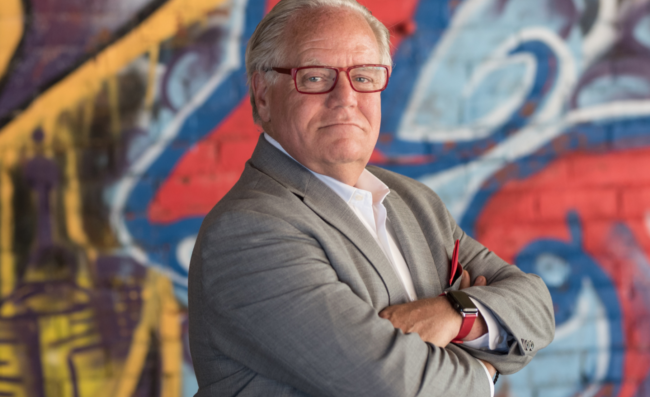
Hosted by top 5 banking and fintech influencer, Jim Marous, Banking Transformed highlights the challenges facing the banking industry. Featuring some of the top minds in business, this podcast explores how financial institutions can prepare for the future of banking.
In this video, Jim Marous broadcasts from Miami’s Wynwood Arts District — one of the most vibrant creative hubs in the world. Using the evolution of Wynwood as a backdrop, Jim explores why so many financial institutions struggle to differentiate, why creativity has become a strategic imperative, and how banks can learn from brands and artists unafraid to take bold, distinctive stands.
From the history of Wynwood’s transformation to the sameness of today’s mobile banking experiences, Jim breaks down the hidden cost of playing it safe and what it will take for banks and credit unions to stand out in a crowded, commoditized marketplace.
If you want your organization to compete on something other than price, convenience, or compliance, this episode is a wake-up call — and a path forward.
Why is it that a street artist with just a few cans of paint can create more differentiation in five hours than most banks can create in five years? Everywhere we look here in Wynwood, Miami District, you see originality, you see identity, you see boldness.
Jim Marous (00:34):
Every wall says, "This is who I am, this is what I represent, this is what I want to share." Now, imagine walking through the banking industry the same way, wouldn't you say instantly that you know what any bank stands for? Would anything feel distinctive, unique, personalized, or does it all blend together into a safe, predictable, beige blur? Maybe it’s blue, maybe it’s green, but there’s such a sameness about everything.
Jim Marous (01:10):
Today, in one of the most creative neighborhoods in the world, let's talk about why banking has become so creatively risk adverse, and what needs to change if we want to stand out in a world with so much noise, so much sameness.
Jim Marous (01:29):
Let's be honest, most banks look, sound, and act the same. Same colors, same promises, same processes, and same digital experiences to do well but not to offend, not to confuse, and unfortunately, not to inspire.
Jim Marous (01:55):
Somewhere along the line, the industry started treating standing out as a big risk. Why do we just avoid creativity? When we've done that, we've avoided evolution, we've avoided a form of innovation, and the cost is real.
Jim Marous (02:16):
When brands blend together, price and convenience become the only thing left to compete on, and that's not differentiation, that is a race to the bottom that most organizations don't even realize is happening.
Jim Marous (02:34):
What makes Wynwood so powerful is that it wasn't always like this. Before the murals, before the color, before the crowds, Wynwood was a forgotten warehouse district. Old textile warehouses, shuttered storefronts, blocks that most people avoided. It was quiet, it was aging, it was ordinary, very much like much of our industry.
Jim Marous (03:05):
But then the artists came not with corporate budgets, not with committees, but with courage. They saw blank white walls where others saw decay. They imagined the possibility where others saw limitations. And that mindset, the belief that you can transform something simply by daring to be different is what turned Wynwood from an overlooked neighborhood into the most creative destinations in the world.
Jim Marous (03:36):
You can literally see the evolution on these walls, these weren't the same 12 months ago. Layers over layers, risk taken, ideas tested, features made public, and new voices rising over the old. Wynwood is creativity in motion where things change every time I come down here.
Jim Marous (04:01):
But in banking, we've worked hard to smooth out every edge. We've avoided those risks, we've kept everything relatively predictable. We tell ourselves customers want safe, we tell ourselves they don't want bold. You know the truth? They simply tolerate what we give them.
Jim Marous (04:24):
Fintechs meanwhile are doing what early Wynwood artists did. They express a point of view. They don't wait for permission, they take creative swings out of the park. Here in Wynwood, blending in is a failure. In banking, blending in had become a common activity, it's become a plan. So, what is this lack of creativity costing us?
Jim Marous (04:49):
We've commoditized everything. When every bank looks the same, price is the only differentiator. Secondly, we've bored customers into the arms of fintechs that at least feel alive. Third, we've convinced ourselves that being boring is what customers want. But look at the brands that people actually love: Apple, Nike, Patagonia, Lego and others — they don't chase everyone, they stand for something and that brings me to a personal story.
Jim Marous (05:24):
A few years ago, I went into an Apple store on launch day, not because I needed a new phone, but because I wanted to watch the energy within the store. People were everywhere. Not just Apple people, but people wanting to see, feel, and buy. Not for a banking product, not for a mortgage, not for a checking account; for a rectangular piece of glass that looked almost identical to the one we already had.
Jim Marous (05:54):
But here's the key, it felt different. The box, the lighting, maybe the colors, the photography, the story they told about what this phone can do. Now, compare that to opening another mobile banking account or another mobile banking app.
Jim Marous (06:15):
While they may perform really well, they all look the same. Same layout, same safe buttons, same corporate blue or green color palette. Meanwhile, Apple turned a routine device into an emotional experience. Creativity didn't just make them distinctive, it made them unforgettable. Banking rarely embraces this. How do we do that in a world where things are possible?
Jim Marous (06:46):
I love street art. Wherever I travel, I seek art out to see how it differs from region to region. Not because it's pretty, but because it represents something banking at some point had; the courage to evolve publicly, to take risks, to embrace color, either in actual transparent color or in the sense of color, contrast, and have personality.
Jim Marous (07:16):
Street art is bold, it's opinionated, it's sometimes political, it's unmistakable. Every mural here in this area reminds me that creativity is not decoration, it's identity and that's something that our industry needs to rediscover.
Jim Marous (07:37):
So, here's the challenge for every bank, every solution provider, actually, every business even outside of banking — what is your mural? What are you building, designing, same or standing for that makes people stop, look, and feel something?
Jim Marous (08:00):
Customers don't want to choose boring. As I said, all they do is tolerate it. They want to choose bold, they want to choose memorable. They choose brands who know who they are. The future won't reward the safest banks, it'll reward the most distinctive ones. So, what will you create that no one else in banking dares to? How will you stand out? How will you be different? How will you embrace change, take risks, and disrupt yourself?
Jim Marous (08:39):
Let's take a short break here and recognize the sponsor to this podcast.
[Music Playing]
Jim Marous (08:46):
So, sometimes I just lack into things. I'm real fortunate to have an artist here that we just met while we were shooting the video.
Louis Burrows (08:55):
Louis Burrows.
Jim Marous (08:55):
Louis Burrows, A.K.A, Style.
Jim Marous (08:58):
And this is one of his works. And so, Louis, you came from this area. You were here when Wynwood Walls wasn't Wynwood Walls, and where the whole area was in a different name, in a different area. So, creativity, we're talking about creativity and the need for all industries, including banking, to become more creative, to think outside the box. What made you create this mural here?
Louis Burrows (09:23):
The love of painting, the freedom of expression on a wall this big.
Jim Marous (09:27):
So, what is different between this piece of art and the other piece of art you've done in the area? Because you've done quite a few pieces in the area.
Louis Burrows (09:34):
We got a few pieces running. This piece, like I said, it was a time restraint, it was something nostalgic to my youth, and I just said, it'll bring cheer to the school on the other side of this wall.
Jim Marous (09:47):
Pretty cool. And you've seen the area completely change from an artist’s perspective, and every year you have art basels, right?
Louis Burrows (09:54):
Correct.
Jim Marous (09:55):
And every year artists come from all over the country, all over the world to put their things on the walls, and actually, in many cases, covering up what was there before. How hard is it to continually transform and evolve and to see walls that once what you believed in change or is that part of the whole mentality?
Louis Burrows (10:14):
To me, that's part of the beauty of it, and that's what brings them here to see the changes, as an artist personally, to see your evolution and growth with your skill, but to meet other artists that you might not have the chance to meet.
Louis Burrows (10:30):
Because I can't travel to Germany, I can't travel around the world, but to have them come here to my backyard and be a part of it, I'm humbled sometimes to be able to meet these guys, sit down, have a coffee, talk about the walls, talk about the area, and they have those same questions: how have things changed? And the quickest answer I could give them is, you're here.
Jim Marous (10:53):
It's interesting because as you walk down the streets, 20 square blocks of art, I mean, it's overwhelming, we just showed a little part of it during my video. But you look, and you probably can identify some of the artists simply by the style they have, the colors they use, whether or not they use cans or they use spray brushes, whatever it may be.
Jim Marous (11:12):
What would be your recommendation to banks that all look and feel the same and are trying to be safe as part of their mantra, but you don't have to be safe when it comes to creativity, do you?
Louis Burrows (11:23):
No, you don't. You don't. Sometimes you have to take that risk. You have to step over the edge and say it's either going to go or it's not, but I'm willing to try. I'm willing to invest, I'm willing to make an effort, I'm willing to see what the prizes are at the end. With minimal effort out here, there's a lot to work with, there's a lot of empty lots, there's a lot of growth, and I welcome that growth.
Jim Marous (11:51):
And there's old murals that time to replace them.
Louis Burrows (11:53):
Time to replace them.
Jim Marous (11:54):
And then rebrand.
Louis Burrows (11:55):
And when you invest and put a new structure in, invite us over, we'll be more than happy to put our art up. It isn't a matter of what we take away from it, it's also a matter of what we give back to our community.
Jim Marous (12:09):
It's emotional. I mean, I've been to Brooklyn, I've been to Sao Paulo, I've been to Paris, I've been all over the world, and every place I seek out this type of art because every place is going to be different, some are very political.
Jim Marous (12:21):
When I went to Budapest, it's a lot of political statements there because the government and everything else. But people can do that, they can tag, they can put up plaster, they can carpet things everywhere. But it's interesting because while there's noise everywhere in a good way, you can distinctively look and see differences.
Jim Marous (12:42):
And for banking in a world that we all try to fit in the same, we got to get away from greens and blues, got to get away from what's normal, got to go beyond just a good app to be a great experience, to make you feel good. That's why we go to Apple, that's why we go to Patagonia, that's why we go to Disney because they branded themselves in such a way, it makes us happy. This is my happy place, Wynwood Walls is my happy place.
[Music Playing]
Louis Burrows (13:05):
It's, if you ask me in the country, one of the biggest outdoor galleries for art. You come here and you could have my work, a Lewis Burrows alongside with a Sharf, alongside with an MSG crew wall, alongside with a Dam crew, alongside with a Didi, a Tatiana, a Quake. Like these are all artists that have made names for themself, a Pixel Poncho around the world, MTO.
Jim Marous (13:32):
And it's emotional.
Louis Burrows (13:33):
And we're here, we're here. And it's a society of people that work together with the same interest of just beautifying our area.
Jim Marous (13:44):
Louis, thank you very much.
Louis Burrows (13:46):
Thank you.
Jim Marous (13:47):
What a great moment to have you stop in your truck, say, "Hey, do you want to know a little bit about what I do?" And we did. And this really fits into what we've been talking about so thank you so much.
Louis Burrows (13:56):
No, you're welcome.
Jim Marous (13:56):
Appreciate it.
Louis Burrows (13:57):
It's always a pleasure to meet new people that come out to my city.
Jim Marous (14:00):
Thank you.
Louis Burrows (14:01):
Thank you.
Jim Marous (14:02):
Thanks for listening to Banking Transformed, the winner of three international awards for podcast excellence. If you enjoy what we're doing, we would really enjoy a positive review. Also, check out my recent articles in The Financial Brand, the research we're doing for the Digital Banking Report.
Jim Marous (14:18):
This has been a production of Evergreen Podcasts, a special thank you to our senior producer, Leah Haslage; audio engineer, Chris Fafalios, and video producer, Will Pritts.
Why Banks Miss Human Customer Moments"Most banks know far more about their customers than the customer ever feels. In this Banking Insight Video, I look at why relationship banking often feels programmed, from the quarterly business banker check-in that g
Banking Transformed
In this Banking Insights video, Jim Marous explores why relationship banking often feels overly programmed and examines how financial institutions...