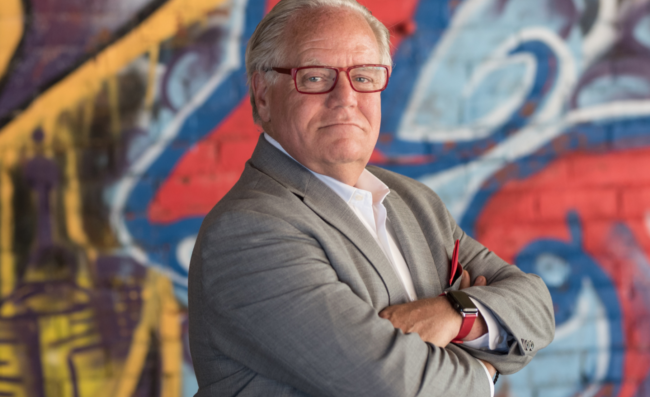
The FIsionaries Podcast, sponsored by Alkami Technology Inc., shines a light on financial institutions (FIs) at the bleeding edge of digital transformation. The podcast, hosted by Jim Marous, features banks and credit unions sharing lessons learned from their digital transformation journeys as well as insights from fintech partners and other industry thought leaders. Each episode will provide regional and community banks and credit unions with insights, tips and tricks to elevate their digital banking game.
State Bank of Texas Pursuit of Frictionless Banking
What does relationship banking really mean when the back office gets in the way?
Live from Alkami Co:lab in San Diego, Jim Marous speaks with John Hutcherson, SVP and COO at State Bank of Texas, about how a highly focused community bank is using digital transformation to make service faster, simpler and more useful for the customers it knows best.
Hutcherson explains why operations are central to the customer experience, especially for a bank serving hoteliers, money service businesses, and relationship-driven commercial clients. The discussion explores how State Bank of Texas is reducing friction, improving workflows, strengthening digital banking, and ensuring technology supports the bank’s culture rather than being layered on top of outdated processes.
This episode is about more than buying better technology. It is about knowing who you are as an institution, listening before changing, choosing the right partners, and building a digital experience that helps employees spend less time processing transactions and more time building relationships.
Alkami Technology, Inc. empowers financial institutions to evolve and thrive in the new digital age of banking. Our premium digital banking platform powers regional banks and credit unions to grow confidently, innovate at speed, and adapt nimbly—all while providing a secure, frictionless experience to the consumers and businesses they serve—24/7/365.
So, Jim Marous here at the FIsionaries Podcast, being filmed at the Gaylord Resort in San Diego for Alkami. Again, as we've always done in these interviews, we try to find those organizations that are punching above their weight in doing things that everybody struggles with.
Jim Marous (00:27):
Digital transformation, it's a journey. It's not a destination. And we're lucky enough to have John Hutcherson here from the State Bank of Texas. So, John, how long have you been at State Bank of Texas?
John Hutcherson (00:42):
Coming on two years now.
Jim Marous (00:43):
Oh, so relatively newbie.
John Hutcherson (00:45):
Relatively newbie for this organization, and I'm glad to be there.
Jim Marous (00:49):
So, what made you select and what made you special to the organization? So, on both sides, it's got to work both ways.
John Hutcherson (00:56):
Right, right. I'm kind of a hybrid. They call it a unicorn. I don't mean that in a braggatory way. I grew up being a teller at my hometown bank. And worked my way through that, went to the city of Dallas, and it was my first real banking job outside of college and all that.
John Hutcherson (01:17):
So, you think you're Mr. Big Shot going to take on the world. And so, I've just been somewhat of a sponge, but been in branch banking to start my career. Become branch manager, regional manager, those kind of things to progress my career.
John Hutcherson (01:33):
And then I got some experience with auditing and operations, and I kind of fell in love with operations. So, yeah, so that's what everyone usually says.
Jim Marous (01:44):
Because everything up to that point had been front-facing.
John Hutcherson (01:47):
Sales, selling investments, relationships, knowing those folks. And what I found in operations was you get the pleasure of still having that customer focus with treasury management or those kinds of things.
Jim Marous (02:00):
So, you managed both the consumer and the business side of operations. And what's interesting, we talk about the importance of relationship banking often in this industry. We don't necessarily do it very well.
Jim Marous (02:12):
We coin it with terms like “We have friendly tellers” or “We try to do what's best for our...” You know all the terms. When you have to actually implement against it, it gets more difficult. And at the end of the day, the back office is what drives how the front office is going to work.
John Hutcherson (02:28):
It really does.
Jim Marous (02:29):
What is the biggest change you were having to make when you joined Bank of Texas to do things differently?
John Hutcherson (02:36):
Well, when you come in new and I got the new guy coming in and trying to change the world. And that's not really the aim I always had. The first thing to do is really, when you first join a new organization, is really just do a lot of listening.
John Hutcherson (02:50):
Just be a sponge at first and kind of learn the culture, of course, mentality. What's the focus of leadership above you? Our executive team, what do they want you to really do? And by listening, then you start looking at workflows and processes and how we're doing things.
John Hutcherson (03:09):
Are they right? Are they wrong? Why are we doing them? Asking those questions. We always ask … new people that come in ask why. Why are we doing this? People don't do that anymore. A lot of people just put their head down.
John Hutcherson (03:19):
They're doing a job, they think if they don't do it quick enough or fast enough or maybe they're letting that task get done longer than it should, they think, “Well, I'm going to work myself out of a job.” But that's not the case always.
John Hutcherson (03:33):
We're trying to be efficient. This world is ever-changing. But coming into this new institution (which I love), it has a very low efficiency ratio, was a big push for me. The standout pick of Texas is (I've been here since 1986) it's been profitable. It's less than 100 employees, it's very efficient already.
Jim Marous (03:56):
How big is it, asset size?
John Hutcherson (03:58):
It's just under $3 billion. It's $2.8 billion.
Jim Marous (04:00):
Okay. Big organization.
John Hutcherson (04:01):
Yeah, so we're in the Dallas urban area. And those are our customers out there. We focus on hotels, hoteliers. We still focus on MSBs (money service businesses) that do a lot of check cashing, and they support the communities they're in.
Jim Marous (04:19):
So, you're working a lot with hospitality businesses, which that sets the bar on how you need to handle your customers because they know how they have to handle theirs.
John Hutcherson (04:29):
Sure, sure. It's a different — we all think of community banking. I don't know what your thoughts are on community banking. We serve our communities, and sometimes we're so quick to want to scale above, get larger asset size, or we're trying to do all these different things.
John Hutcherson (04:43):
We still need to focus on our community and who we're serving. Don't forget the philosophy of that. So, a lot of times we're getting to do digital banking and these things that come. AI this, AI that. And you still need to focus on what we got you here and that's what they really do.
Jim Marous (05:01):
Yeah, it's interesting because when you think about relationship banking, it all feels like outward-facing things. But being the director of operations, obviously you understand that you can only fake it so far that the back office has to be able to support.
Jim Marous (05:17):
Especially when you go beyond the simple nits and nets of banking and get into the real world of relationship banking or the real world of knowing your customer. The real meaning of digital transformation, because we've talked about it before.
Jim Marous (05:32):
You can't just turn paper into PDFs. That's not digital transformation. You have got to rethink what you do in the back office. But you came into State Bank of Texas two years ago. So, while that was on the mission list (I'm sure), you also had a challenge because you were new.
Jim Marous (05:47):
So, you had to change the mindset of people around you, at least some of the people, from their standpoint not that they weren't willing to do what you wanted them to do, but everybody's got in the back of their mind, “Is this going to cost me my job? Am I going to outplace myself?”
Jim Marous (06:01):
How do you go about the digital transformation internally? You know what your mission is externally, but how do you sell it to the people that handle those internal jobs that traditionally, in most banks, have a great legacy, a long time?
Jim Marous (06:17):
You're two years in the bank or zero days in the bank, and you're dealing with people that have been 25 years, and they would love to tell you that they know how it has to be here. How do you make that change happen?
John Hutcherson (06:27):
It's hard. It comes back to what I was talking about when we first got there, is that is hard. It was hard to come in and do that, replacing someone that had been there for a very long time in certain ways. That's always a struggle.
John Hutcherson (06:40):
If you're coming in and you want to look at processes and make them easier, make them better, make them more efficient, you've got to get the buy-in from the group, each group. The first thing I did was, “Oh, you're going to be on the executive floor.” “No, no, I'm not doing that. I'm going to be down on the first floor with my groups, learn who they are, what they're doing. Not as a micromanaging piece, but really look and see what they're doing.”
John Hutcherson (07:06):
A lot of times people just manage from a desk or manage from a … we're all remote now. We're all trying to train people in this remote world. So, I think the leadership of your departments that you're dealing with, you've got to get their buy-in.
John Hutcherson (07:20):
You've got to get them to understand what they bring to the table. A lot of it is assessments, too. Are these people in the right positions? Are they going to be used in the best way possible by what they're still doing?
John Hutcherson (07:35):
So, it is a transformation, but I think what I was getting at too was they need to figure out all those processes and workflows. Work them out. You got to get them all on — I'm a visual person. So, you just get it on the board, start processing workflows, and finding gaps.
John Hutcherson (07:59):
But getting your team with you, not just coming in and saying, “Okay, I'm going to fix this. This is what we're going to do.” It's a team effort.
Jim Marous (08:04):
Plus, it's a moving target anyway. They've done things before you got there. They'll be doing things after you leave. And when you started … and this is interesting because a lot of times, we interview people that have been with the organization for quite a while.
Jim Marous (08:18):
So, you came in knowing where the organization was, the momentum it had in different aspects. But you're also looking for (because it's a normal behavior of a new employee), where can I put my stamp on something?
Jim Marous (08:30):
Not for an ego base, but what's my first thing … what am I going to prioritize and what am I going to fix? What was the first thing from a digital transformation perspective in a relationship-based organization that you said, “This is what we got to fix?”
John Hutcherson (08:44):
That was easy because I knew right away the bank I came to, we were on the same platforms.
Jim Marous (08:50):
That helps.
John Hutcherson (08:51):
It helps a lot. And that's one of the reasons I think they brought me in. And so, I knew right away, of course, that we had the same struggles. So, that was our first commonality right off the bat. I knew, “Okay, we all are struggling with X software, whatever it might be. One of our cores or whatever it might be. We all have our banking core issues.”
John Hutcherson (09:08):
But yeah, coming in and saying, “Okay, what are you guys …” like I just said, we're assessing the same problems we've had. How do we fix them? What do we want to do? So, I have a great leader, my boss, Jenna Hayes, who said, “Just roll with this. Well, I hired you. Let's talk about online banking, let's talk about digital banking. Is that a savior to everything?” “No.”
John Hutcherson (09:30):
But when you do get a digital banking platform, it gives you the total opportunity to go look at those workflows, your operational workflows, because that's what it is. Are we just going to lay this technology on top of old workflows? No.
Jim Marous (09:44):
Pay twice.
John Hutcherson (09:45):
Right. So, it's almost like, yeah, you're buying something nice, a nice jacket, nice coat, whatever it is, a hat. But if you're doing the same things with it, it's not going to work. So, you find those opportunities where you can help your customers.
Jim Marous (10:00):
So, I was a customer at State Bank of Texas four years ago, let's say, and today, I'm coming in to deal with my banker. What will feel different because of the impact you've been able to make over your relatively short tenure?
John Hutcherson (10:17):
I think, well, first of all, service. Let's just get that out of the way. That's the first thing from a philosophy perspective.
Jim Marous (10:24):
What?
John Hutcherson (10:25):
Service, service. When we came in, I always kind of joke about this, but we want to be the Chick-fil-A of banking. We want to have that service. If we don't have that answer, let's give them an answer even if we don't know the answer yet. Let them know that we're working on that answer.
John Hutcherson (10:40):
So, service is the first thing. But when they come in and they see that we've listened to them, listened to our customers, and tried to anticipate their needs – from a hotel perspective, what do we know? We know hotels. We know that they-
Jim Marous (10:52):
Use the data.
John Hutcherson (10:53):
Right. So, what do we need to do? What they'd see new or different is they can move their money more easier now, going from one platform to the other. So, their big thing was operating expenses, running the hotel.
John Hutcherson (11:07):
They need those funds to be moved in, moved out, not having to worry about friction and those kinds of things within a platform. So, they're going to see a new, fresh look. It's a little more modern. But have the same philosophy behind that.
Jim Marous (11:29):
So, let us take a short break here and recognize the sponsor of this podcast, Alkami Technologies.
[Music playing]
Jim Marous (11:39):
Welcome back to the FIsionaries Podcast, sponsored by Alkami Technologies.
Jim Marous (11:44):
So, how do you balance speed (which is one of the aspects of service), accuracy, security, trust, and the humanized feel even to a digital transaction? How do you balance that? Because it's a strange dynamic, and one can work against the other sometimes.
John Hutcherson (12:06):
And people might think those are opposites.
Jim Marous (12:09):
Speed and security.
John Hutcherson (12:10):
Yeah, it's not. It’s with the convenience, those things that are just simple things that we need to get done, you want it to be a simple process. And with security, that's going to build you the trust.
John Hutcherson (12:21):
Be more transparent with that. Tell them what you're doing. Tell them the features we have. Tell them what we've gone through A to B. We're doing things differently now, so be transparent. Tell them what we're doing.
John Hutcherson (12:32):
We're always wanting to hide processes, which we do need to do that to some degree, security things. But if your customers know that you're taking these steps to protect them, the trust built in itself. You don't even have to work that hard at it. So, yeah, there is a good balance.
Jim Marous (12:52):
Convenience is wonderful when we get into these bigger pieces. If you're a consumer versus a business, you want the same setup. You want the same highway they're all on. But some things take less time than others.
Jim Marous (13:06):
So, how do you do that? Because certainly even two years ago, digitizing the consumer journey is easier than digitizing the business journey for various different reasons that are far above my pace. I don't understand them all.
Jim Marous (13:20):
But how have you tried to unify the way you address both markets so that it's easier for your employees, your staff, your peers, everyone else to understand this is the way we're going to do things because it makes it so that if we have something we want to change again, it's easier the next time around?
John Hutcherson (13:39):
Well, I think you've got to have an end game. You have to have some sort of a goal with your groups. When it comes to a digital transformation, we can't just say, “Okay, we've got a new online digital banking product. Let's go. Ready? Going.” No.
John Hutcherson (13:55):
But it is though, “We were here. How do we get to here?” What are we trying to do? Are we trying to grow our asset size? Are we trying to make everything less friction for our customers?
John Hutcherson (14:05):
I think a lot of times we take processes and try to — I say this about digital banking, that it’s not the junk drawer of the house. You open that junk drawer; it's got spatulas, and it's got all the things that we hardly ever use. You don't want that to be your digital banking platform.
John Hutcherson (14:21):
You want to have customers be able to go in there and do things with it. Not just, “Where are your locations?” or wherever they're specifically looking. But I want to be able to do something when I'm on that website to get something done.
John Hutcherson (14:33):
If it's talking to someone in chat, if it's opening an account, if it's a transactional dispute, you want to be able to do those things with your site, with your digital banking platform. And then it kind of goes from there.
Jim Marous (14:47):
So, right now at your bank, we have a customer journey. Tactically and specifically right now, what's the part of the customer journey you're trying to fix the most right now? What's prioritized from the customer journey?
John Hutcherson (15:00):
Friction. Friction in what we're doing.
Jim Marous (15:03):
In the whole process?
John Hutcherson (15:04):
The whole process. Just whenever something's simple to get done. It might be sometimes these things you can't necessarily fix. But we're trying to anticipate what the hotels are going to need.
John Hutcherson (15:16):
We have hotels and we have our money-service businesses. How do we keep those? Those are our bread and butter, that's what we do. How do we make that their process is less frictional?
John Hutcherson (15:27):
Is it one, we have some that are maybe in California, they're having cash issues. They're not banking around our branch every day. So, sometimes it's like, “How do you run that versus a hotel?”
John Hutcherson (15:40):
So, hoteliers, they need things quickly to make decisions, just like any business owner. So, when you look at those two different dynamics of a customer, you have cash needs and you have payment needs, maybe. And how do we improve on that?
John Hutcherson (16:02):
With digital banking, for a hotelier, they have issues when they're trying to make payroll or they're trying to get a lot of credit or they're trying to whatever it may be. So, we want that to be frictionless. There wouldn’t be a stop when they're trying to move money.
John Hutcherson (16:19):
Or you mentioned convenience and security. That's a big thing. How much do we let a customer have access to their funds to go in and out? We’re always—
Jim Marous (16:27):
See, you have to pick partners to make this happen. This is not something you can do all internally, especially at your size. How do you select your partners for specific solutions? That are maybe saying they're going to be provided by your core, not provided the way you want to be.
Jim Marous (16:44):
When you’re at the Alkami CoLab process, how are you going around the rooms to find out, “I really want to talk to that company?” What stands out with your partners?
John Hutcherson (16:56):
Well, I love it when they – we've been on roundtables the past couple days. It's the best thing to do. We can all have all these breakout sessions when you listen to other people and what they're doing and what's not working, what is working.
John Hutcherson (17:09):
It's really easy here because their folks are here, you can go talk to some of these folks. But a lot of the time, I'm talking to maybe other banks that are on my same core, which we talk to others with different cores, but it's all word of mouth, too. “What are you using? What's out there that we could be using?”
John Hutcherson (17:27):
Now that you have AI functionalities to be able to pull up anything and you find so much more information now than we thought we could, it's still talking to your colleagues, talking to the others that are in your same world. Banking is a very small world.
Jim Marous (17:43):
That's interesting. The whole concept of CoLab is collaboration. And it seems like there's a very distinct segment that this event serves the best. And the interaction is what really makes it all work beyond even the meeting with the partners that can build solutions.
Jim Marous (18:01):
And as you said, I'd like to find more like me so I can say, “Okay, I got one major issue that's got a burr in my butt, and I got to fix that.” But it's good because it gives that outside-the-normal entity. They're not the same kind of industries, not even serve the same kind of customer.
Jim Marous (18:20):
But you have a very large consumer or commercial side of the business. And so, you've got to make sure that catches up to where the consumer side is in the way you service customers.
John Hutcherson (18:30):
Absolutely. You're exactly right. With those hotels and MSBs, we're just constantly … what we’re talking about here. I actually found another bank that was doing hoteliers as well, which we're such a niche bank. And then last night, I was talking to this wonderful person-
Jim Marous (18:50):
And it doesn't say on the name tag that you’re a niche bank.
John Hutcherson (18:51):
Yeah, it doesn’t say what they're doing. It just says where they're from. And I said, “Oh, yeah, we do hotels.” “Oh, we do hotels.” And it was just almost like finding a friend off the reset when we were kids.
John Hutcherson (19:02):
Yeah, so that's the one thing you're right. It's like a collaboration here, but it's also almost like a therapy session as well, too. So, if you have some of the same struggles, “What are you guys doing?”
John Hutcherson (19:17):
That's what I always like, too. There's times when I've been a referral for Alkami because I want to hear what others are doing. It's just not for them to use that reference or referral for that.
John Hutcherson (19:28):
Alkami's been a great partner so far. We're real excited about it. Been a big rah-rah for them. We're glad to be in partnership with them. They really kind of get what the word “partner” means, “partnership.” I think a lot of the-
Jim Marous (19:44):
Right, and in fact, you're also helping your partners get better. It's something that didn't exist in this industry for years. It was always, “You take what the partner gives you, that's pretty much the way it is,” and it depended on your size of organization.
Jim Marous (19:58):
Now, because so much is happening so quickly, the partners are actually listening a lot more to their clients because clients sometimes have an idea that will be able to be distributed across the marketplace.
John Hutcherson (20:09):
Yeah, bankers get a bad rap, of course, we're logged in there with lawyers and such. But when we get together, it's not really about we're not competing for a lot of different things. And we're both all in this kind of a cult.
John Hutcherson (20:26):
So, we all try to help each other. At the end of the day, we're all trying to get the real story, get the real scoop, what's good, what's bad. We're all living in this world of adaptability. That's what I would tell anyone that says, “Hey, what do you see down the future of banking?” It's adaptability is going to be a big thing.
Jim Marous (20:49):
So, right now, top of your priority list, what are you trying tactically and strategically to solve for right now at your institution? What's the thing that you hope by the end of the year, you'll be able to say, “We figured this part of it out?”
John Hutcherson (21:03):
Well, it's a little more, we've become — our bank, we want to be less of an order-taking bank and more of a relationship-building bank. And so, when you have a digital transformation like this and you build it, you build it so there's not the friction for your employees. So, those employees can have-
Jim Marous (21:22):
Employee experience.
John Hutcherson (21:23):
Yeah, they can enjoy the relationship. You can enjoy the relationship with your client, focus on that a little more instead of, “Oh, as soon as they're gone, I have to go do this and do that, and got to go fill out a form” or whatever that is. We try to get rid of that.
John Hutcherson (21:40):
Well, if we can do that, that's the first thing I would love to be able to do and say, is we're a good relationship-building bank. That's what we're focused on, it's almost like a ship.
Jim Marous (21:49):
It's not just talk.
John Hutcherson (21:50):
Yeah, and it's a ship. It's like steering a ship. You're turning it, and it's getting there. It's getting there. My employees and my boss probably get tired of me using that cliche, but it's like that. It's like a big cruise.
Jim Marous (22:04):
Still trying to be the motorboat, though. You're still trying to be the little boat.
John Hutcherson (22:08):
You can't go in there and change it overnight. We all want to do that, and there's some pieces to that you can. With Alkami, it's been a good experience because a lot of our customers are, I don't want to say they're coming back, but they're using our bank more for their process.
John Hutcherson (22:25):
That's what you want. Those are our partners. We lend to those folks. We want them depositing with us. We want their families back in here. That's what relationship banking is all about. So, that's what we're trying to really accomplish.
Jim Marous (22:35):
So, if you have to give one piece of advice to your peers on how to succeed the way you have in digital transformation (to the degree you have or in the areas you have), what's that one piece of advice?
John Hutcherson (22:51):
Don't go out and just buy technology. Figure out the technology.
Jim Marous (22:54):
That's easy.
John Hutcherson (22:55):
Yeah, it's easy to buy it. You really need to figure out who you are as an institution. Because you don't want to just buy that technology, slap it on your own process, like I said, and do that. You really need to figure out who you are, what's your culture. And don't just look at price. We all say that easily. We all look at these things and put a lot on the price tag.
Jim Marous (23:20):
That's a great piece of recommendation. I think we think that you can buy it and it fixes itself. Or that if I buy this solution, I'm going to get what they promised in the sales pitch. You got to be a participant.
Jim Marous (23:35):
We say it often that sometimes bankers got to get out of their own way. Because that can make technology fail really quickly. And again, if you don't know your North Star, if you don't know where you're going, you won't buy the technology that's going to get you there necessarily the most optimized way, as you mentioned earlier.
Jim Marous (23:52):
Because you're simply directionally going, “Okay, I'm going north,” as opposed to, “I'm going to this point north.”
John Hutcherson (23:59):
So, figuring out … like I said, we didn't have an identity problem. We just wanted to go to a different — take a step above and start creating that philosophy in the bank. We wanted to really all be rowing the same direction, as they say at times.
John Hutcherson (24:18):
Even if you have a small bank or even a large institution. Large institution, of course, you have all these silo areas, and community banking is different. It's wearing lots of hats, you're doing things. Get down there.
John Hutcherson (24:30):
And my boss and I have worked tasks down there in our operations group. That's just what we do. We're all working managers to some degree. And community banking is just like that. It's you're fixing the light bulb or you're picking a piece of trash off the ground, or you just kind of go with it and help out where you can.
John Hutcherson (24:48):
And that's just our philosophy. That's my philosophy in community banking.
Jim Marous (24:52):
That's great. John, thank you for your time.
John Hutcherson (24:55):
Oh, you bet. Enjoyed it.
Jim Marous (24:55):
I really appreciate it. It's neat because these interviews, the podcasting business, and talking to financial institutions of all sizes – there's not one of these engagements that I don't learn something that I didn't know before.
Jim Marous (25:08):
And as you've mentioned too, that's kind of why you're doing it. Because if you sit still, you're going to be out of business personally or professionally in one way or the other.
John Hutcherson (25:18):
Well, we're still in the people business. We deal with people all day long. My employees, we're with them all the time. I always tell them we're together more than our families at times, so let's figure this out.
Jim Marous (25:27):
The same dynamics, exactly.
John Hutcherson (25:28):
Yeah, they may not feel the same way, but we'll see. But anyway, I enjoyed it.