
Living for We, Season 2: Keep Ya Head Up
Every bullet fired creates two victims: the person who is shot and the one pulling the trigger. It’s a traumatic experience for both; the victim may lose their life, and the perpetrator may lose their freedom. This season, we're asking what can be done to end cycles of violence in cities like Cleveland, Ohio when the shooters value their reputation over their own lives and see innocent bystanders as collateral damage.



S2E8: A Second Chance
| S:2 E:8Young Black men often don’t get second chances in the U.S. criminal justice system—but a new pilot program in Cuyahoga County is trying to change that.
Take Andrew Hogan, for example. He was just 20 when he and his date were approached by the police. There was an illegal gun in his car, and that got him locked up. Andrew admits he knew he wasn’t old enough to legally have a gun, but he felt like he needed it to protect himself. After the arrest, he started to lose hope—he was facing serious charges and even lost his job.
But then Andrew was referred to the Cuyahoga County Common Pleas Court Violence Intervention Program—aka VIP. It’s a new program designed to help young people caught with a gun that hasn’t been used in a crime. Instead of punishment, the program offers a shot at redemption: support, a path to clear their record, and a fresh start.
VIP was launched by Judge Brendan J. Sheehan, who also oversees it. In this episode, he explains that the goal is to keep young, nonviolent offenders from ending up as gun violence or homicide statistics. The program brings in peer mentors, trauma counselors, and job placement help—all focused on helping young men, ages 18 to 26, from Cleveland neighborhoods hit hardest by gun violence.
The program runs on a three-year, $750,000 grant from the U.S. Department of Justice. While many violence intervention programs across the country have seen their funding cut recently, VIP has been lucky—its funding is still intact. That said, some of its key partners are facing cuts, including the Cleveland Peacemakers Alliance, which is run by our podcast co-host Myesha Watkins.
View our full list of resources here.
Have you or someone you know been impacted by gun violence? Or do you have any thoughts about what was shared in today’s episode? Share your story for a chance to be featured on the show!
Where to Listen
Find us in your favorite podcast app.
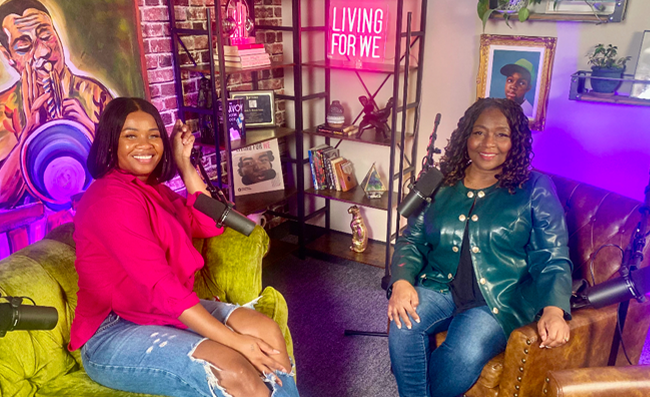

Voiceover:
Living For We is part of the Connecting the Dots between Race and Health Initiative from Ideastream Public Media made possible by generous support from the Dr. Donald J. Goodman and Ruth Weber Goodman Philanthropic Fund of the Cleveland Foundation and made possible in part with support from Enbridge Gas, Ohio.
Marlene Harris-Taylor:
Warning, this episode contains descriptions of violence.
Myesha Watkins:
Viewer discretion is advised.
Marlene Harris-Taylor:
Today, on Living For We: Keep Ya’ Head Up.
Andrew Hogan:
One of my friends got shot in his leg and went in and out and we had to carry him, put him in my back seat and drive him to the hospital. It's a lot of things that I've experienced that led me to the point where it's like, “I will not be a victim.”
Marlene Harris-Taylor:
Welcome to Living For We: Keep Ya’ Head Up. Myesha, there's so many young men in our community who get caught up, they're not really doing anything violent, but they have a gun or something like that, maybe they have some weed in their car and it turns into a bigger problem. They get caught up with the police and end up in jail.
Myesha Watkins:
And it's so unfortunate but I think because communities that are impoverished, like the city of Cleveland are over policed. So, they just assume that you fit the character and they handle every situation like the last, instead of really being intentional about what's going on.
Marlene Harris-Taylor:
So, we're getting ready to talk to Andrew Hogan, who's one of those people who, he had a gun in his car and he admits he was underage, he should not have had the gun but at the same time he had a dilemma because he didn't feel safe without the gun.
Myesha Watkins:
Yeah. And I think that's the part that people who aren't from community don't understand is that oftentimes young people or people in general do not carry guns because they're violent or criminal, it just don't feel safe. But even your fear can put you in a situation of greater fear because it can lead to incarceration or death.
Marlene Harris-Taylor:
Now, the good news is Andrew's story has a happy ending because of this wonderful program in Cuyahoga County, Common Pleas Court.
Myesha Watkins:
Yep, the Violence Intervention Program and basically young people who are caught with a firearm that wasn't used in an illegal or criminal activity, they're given grace over guilt where community comes into the courtroom and we really try our best to remove the barriers and offer solutions so that this young person will not be marked with a felony, but yet have a clean background and surrounded by people that care.
Andrew Hogan:
At the time, I want to say I was in Euclid, I was way out of our neighborhood. I was an the area where the neighbors, people in the neighborhood they call if they see anything that was unusual, and I guess my car was unusual.
Marlene Harris-Taylor:
What was unusual about your car?
Andrew Hogan:
Pretty fast car, it was a Challenger. I guess they just wanted to come do a wellness check, but from then on the wellness check turned into a search and seizure of my vehicle, so-
Marlene Harris-Taylor:
So, what made them want to do a wellness check?
Andrew Hogan:
I guess they claimed that I'd been sitting there for too long.
Marlene Harris-Taylor:
Ah, okay.
Andrew Hogan:
And that wasn't the case, but I went along and complied because there was nothing really else I could do.
Myesha Watkins:
I'm so glad that you complied though, because the interactions with black men and boys with law enforcement doesn't always result in somebody being able to walk away. So, I'm glad that you complied and that you're here today to tell the story.
Andrew Hogan:
Yeah, definitely. I do get a little nervous, but I was always told in a situation like such, just follow the necessary precautions.
Marlene Harris-Taylor:
And how'd it go from them showing up to you being incarcerated?
Andrew Hogan:
To be honest with you, I forgot what it was that gave them probable cause of searching my vehicle. They just said that it was an ongoing investigation. And I had a firearm in my vehicle at the time. This was September 2023 and I was only 20 at the time, so I was underage. I knew I was underage, but as I told you earlier, like I was a high-profile car, I would say, so-
Marlene Harris-Taylor:
So, you felt like you needed the gun?
Andrew Hogan:
Yeah, I need to feel safety or protection. So, from that point on they asked me to step out the car and I told them that they didn't have probable cause but they came with, “Either you're going to get out the car or we're going to force you out the car.”
So, after that, they took me out the car but as I'm getting out the car at this point, I'm thinking like, “Would I rather them find a firearm in my vehicle or would I rather just let them know so that there's no harm done to me.” Because I'd rather, like I said, leave out of this situation, be able to go home.
So, I told them like, “There's a firearm under the passenger seat.” At the time, a girl was sitting in the passenger seat, so they cuffed her too.
Marlene Harris-Taylor:
They cuffed her too?
Andrew Hogan:
Yeah.
Marlene Harris-Taylor:
Why?
Andrew Hogan:
They said she was an accessory to the crime.
Marlene Harris-Taylor:
The crime of you having a gun in the car.
Andrew Hogan:
Yeah. Which was kind of confusing for me. But as they were detaining her, I told them that it was my firearm and that I would claim it. And they said for the time being, for their safety and mine, that they would just detain everybody and put us in the back of the car. So, they continued their search, but they were looking for something that wasn't there and that it drained my character that day though.
Myesha Watkins:
Why did you feel like it drained your character?
Andrew Hogan:
Because they perceived me to be doing something that I knew I wasn't. At the time I was upholding the job, and it was something that I was proud of.
Marlene Harris-Taylor:
You're 20-years-old, living your life, working a job, out on a date and then they're suddenly looking at you as a criminal.
Andrew Hogan:
I winded up becoming incarcerated that day. I went to jail, I think I was in jail for probably like a week.
Marlene Harris-Taylor:
A week?
Andrew Hogan:
Yeah.
Marlene Harris-Taylor:
So, what were you thinking for a week in jail? I mean, I would've been going crazy in my mind that happened to me. What were you thinking?
Andrew Hogan:
It's funny that you say that, but a lot of my friends were in there.
Marlene Harris-Taylor:
Really? Okay.
Andrew Hogan:
Yeah. A lot of people who I either had a close bond with previously or people who I just known throughout my life.
Marlene Harris-Taylor:
Did that mess up your job?
Andrew Hogan:
I winded up losing that employment, yeah. And from then on, once charges started being read and repercussions started adding up with me with the charges or what, timeframes of jail, I started to lose all hope.
I was discouraged; I bonded out. I wanted a bonding out. Once I went home though, it was like starting straight from scratch. I had literally nothing. It was hard for me to even maintain employment.
I remember once I was working at Giant Eagle in Beachwood for literally a week, once they get the background check, I'm no longer placing bananas out there in the produce section. So, I'm just like, dang. And that's not the worst felony that you can get, that's a nonviolent offense. Still can't even keep a job at a grocery store.
Marlene Harris-Taylor:
At Giant Eagle, putting out bananas.
Andrew Hogan:
I couldn't get hired at McDonald's if I wanted to.
Myesha Watkins:
Not being violent nor a criminal but wanting to carry a gun for your safety. What was the moment that you knew that you needed a firearm to feel safe?
Andrew Hogan:
I've experienced robberies, home invasions, shootings, I've even been the victim of drive-by shootings and you see people get shot in the leg or get shot in the chest and you see a hole ripped through and this blood gushing out.
One of my friends got shot in his leg and went in and out and we had to carry him, put him in my back seat and drive him to the hospital. It's a lot of things that I've experienced that led me to the point where it's like, “I will not be a victim.”
Myesha Watkins:
How did you end up in Judge Sheehan program?
Andrew Hogan:
I talked with my probation officer as a way for them to, I guess interview me to see if I was qualified for the program.
Marlene Harris-Taylor:
What'd you think when they first told you about it?
Andrew Hogan:
I was excited not to have to go to jail, definitely. Because it's not often that you get chances to correct situations like that. I thought it was like, this is a pivotal moment of my life, I just made a very vital mistake and I could potentially — and if not, I had so many doubts that I was just going to go to jail anyways.
But given the second chance and me seeing my friends literally sitting in jail for if not worse, then the same things and they didn't receive that second chance or this may be their second or third strike, they may not receive any opportunities to ever see their family ever again but I was just grateful.
Marlene Harris-Taylor:
Yeah, I get it. So, what was it like going through the program? What did you do? What did they have you do?
Andrew Hogan:
It started off with phase one and phase one was basically just me and my probation officer coming up with different plans in order to just maintain my safety, that was number one for her. She wanted to make sure that wherever you are, that you're safe.
Marlene Harris-Taylor:
So, then what was the next part of the program?
Andrew Hogan:
Phase two, just making sure that I abstain from substance abuse, same like no firearms, no substance abuse, maintain steady employment. That's like the biggest accomplishment. Like people was telling me, “You could be facing six years in jail.”
Six years turned into a year and a half of probation. A year and a half of probation turned into me going to St. … to go talk to some kids about gun violence and substance abuse and different things it is that you're supposed to do as a child.
Marlene Harris-Taylor:
What age were the kids?
Andrew Hogan:
I think they were eighth graders. I believe they were eight graders.
Marlene Harris-Taylor:
I'm curious, what did they want to know? The eighth graders.
Andrew Hogan:
They wanted to know if I had a dog, do I got a girlfriend but some of the more questions with more substance were why did I feel the need to have a firearm or what is it that landed me on this program?
And the basic, or the most low-down example that I could give you is that I wasn't abiding by the law, they could say I was 20-years-old, I had a unregistered firearm in my vehicle and that was it. I mean, that's breaking the law, so I basically just told them not to break the law, don't do that.
Marlene Harris-Taylor:
So, what was it like? The graduation ceremony.
Andrew Hogan:
Graduation was a day like no other. I felt like that was better than when I graduated high school to be honest. I felt proud of not only myself, but everybody else that was sitting in the room too. But once I start submitting paychecks or pay stubs even and I start realizing I'm kind of making a little money here.
That little certification, like I am around some different people too, they share the same interests as me and they mean well and better for me too so how could I ever feel as though I'm not safe around people who want to see me safe, want to see me succeed? So, it felt great to be in a room full of people that were smiling at an accomplishment that I had.
Myesha Watkins:
That's so dope.
Marlene Harris-Taylor:
So, after graduation your record was expunged?
Andrew Hogan:
Definitely.
Marlene Harris-Taylor:
Sounds like you have a whole new mindset after graduation.
Andrew Hogan:
I no longer stay in a state of fear because fear doesn't motivate me at all. I more so along the lines of what can I do to better my future or even the people around me, because you stay in a state of fear, that's all that you're going to be entrapped in and it could be a constant ongoing cycle. I know people that's scared to come outside right now. I don't live in fear at all.
Marlene Harris-Taylor:
What's the best thing that's happened to you since graduation?
Andrew Hogan:
I signed up for nursing school. That's going to be probably the best thing.
Marlene Harris-Taylor:
That's wonderful.
Andrew Hogan:
Yeah. I mean, if I can be a light to shine, who knows, maybe I could possibly shed some light on anybody else's situation.
Myesha Watkins:
And you will. It's not possibly, you already are.
Andrew Hogan:
I mean, I feel like what happens when a lot of people come together and make a contribution of time and effort. I was always taught as a child, there are two things in your life that you're going to spend and you are never going to get them back and that's time and effort.
It's not money because money is something that's materialistic, it's tangible. But when you spend time and effort on whatever it is that you're doing, it's either you're just going to see the benefit of it or you're not.
So, I don't give up when things get hard, and I try to give up on myself at times, but I think about how many other people it is that's in either the same situation as me or worse. It's like, “How can I give up now when they didn’t?”
Marlene Harris-Taylor:
Andrew, he is a poet.
Myesha Watkins:
Very wise, beyond his years, you can tell that he had an amazing foundation to start from.
Marlene Harris-Taylor:
And thank God for this program so that he's not sitting in jail somewhere because he was carrying a gun at 20-years-old.
Myesha Watkins:
For his safety.
Marlene Harris-Taylor:
For his safety. So, this program was started by Judge Brendan Sheehan in the Cuyahoga County Common Pleas Court and it's very unique, yep.
Myesha Watkins:
And the cool thing about it is that Judge Sheehan invites community inside the courtroom because he understands that this problem is bigger than a gun, what barriers are impacting your life that allowed you or made you feel the need to carry a firearm and then how do we provide resources to that so that you do not fall deeper into the justice system?
Marlene Harris-Taylor:
So, great to have a judge that has empathy and is thinking about how to keep people out of jail instead of how to put people in jail.
Judge Brendan Sheehan:
Well, in 2008 I started seeing young men, because I'll say young men, an African American coming into our court, committing crimes with guns, sometimes using a gun and going to prison.
And then I'd read the newspapers and I'd listen to the news and I'd see stories and hear stories about violence in our community, violence in Cleveland, how Cleveland's the worst place in the world to live as you know.
Marlene Harris-Taylor:
Are you talking about first season of Living For We?
Judge Brendan Sheehan:
Yeah, first season of Living For We Podcast. Exactly. And I said, there's got to be something more as a judge, as a leader in our community, we can do. So, I came on a whim and I started a pilot program back in 2013 is when it started. I started talking to community leaders and how could we do this and people laughed at me like, “Sheehan you’re crazy.”
And we brought all these folks together and I convinced our court to say, “Let me have a pilot program. And this pilot program will consist of me, the judge, a specialized probation officer, and the Cleveland Peacemakers, and let's see if we can do something.”
Marlene Harris-Taylor:
Myesha’s organization.
Judge Brendan Sheehan:
Myesha's organization. Let's bring these folks together and let's see if we can make a difference. Well, we started out in 2013 on a whim and just try to watch what was going on and all of a sudden, through me going out in the community, I ran into this lady in Metro Hospital, and I said, “Hey, why don't you come watch this doc and see what you think?”
And she was a trauma counselor and she watched, and I knew every one of the guys who was in our court at that time, they were smoking dope, they were dealing with stressors in their lives and she goes, “We can fix that.” I go, “What do you mean?” And she goes, “There's trauma here.” And I said, “Well, what do you have to offer?” She goes, “Well, let's talk to some of these young men who's in your program and let's delve into a little bit behind, let's peel back the onion, if you will.”
Marlene Harris-Taylor:
Peel back the layers.
Judge Brendan Sheehan:
And they peeled back and here we find out they witnessed murders on the streets, they've witnessed a family member violence, they've seen shootings, they've been shot at, they've been victim of gunshot wounds and all of a sudden it was like, “Okay, we bring the trauma piece in.”
Marlene Harris-Taylor:
So, the light bulb went off there.
Judge Brendan Sheehan:
The light bulb went off and all of a sudden, so we have the Cleveland Peacemakers, we have OhioMeansJobs, we've got the trauma counselors, we get them into the program, they're caught with a firearm, a nonviolent firearm with them. Right now, the county prosecutor, the Ohio public defender all agreed to help out on this and said, let's-
Marlene Harris-Taylor:
That's awesome.
Judge Brendan Sheehan:
Let's put this team together and let's do something.
Myesha Watkins:
Young people being caught with the firearm is what gets them there. What problems do you uncover once they're there through this multidisciplinary team?
Judge Brendan Sheehan:
Well, first, when they get into the program, we start first their living conditions, they have known that they have a chance, that they’re worthy, that they’re smart, they can do something. They’ve been given no opportunity with employment because of criminal records, because of the felony records, the arrest records. Even an arrest record, no one’s going to hire anyone with an arrest record for a gun.
And then we find out another barrier is that their living situation is, they’re in a neighborhood where, “Why did you have a gun? What were you thinking? Why did you need that gun with you?” Because they’re fearful.
Marlene Harris-Taylor:
They’re fearful, they carrying a gun because they feel like they got to have a gun.
Judge Brendan Sheehan:
Because of gangs. Gang activities.
Myesha Watkins:
And so, one of the things that we noticed through this program is that we take the young person out of the community and we hope that all of the things that we're instilling in them, that they can go back to this disease environment and be one of many people.
And then too often they hit another wall and challenge, because we're not supporting the entire community, we're supporting this one person. So, how do you speak to young people that come to you and say, “Judge, I'm trying, but every time that I try, my family isn't supportive and then they push me out.” How do you speak to that?
Judge Brendan Sheehan:
They look at me and say, “Sheehan, you don't know what I have to do, you don't know my walk.” And I sit there and I say, “You're right. But our team has been there and members of our team there, we want to help. It's not trying to make more burden on you to do something, it's to help you.” Because they've been in those situations and they've had those barriers in their faces.
So, we had a young man who was in the program and he lived on the east side of Cleveland. He had a family member, have a birthday party, gets on a bus, goes to the party, he's at the bus stop leaving the party, and he gets robbed. He gets robbed by two gentlemen and he gets shot.
I get notice from our probation officer that night, and I'm thinking, “Ugh, so much for my pilot program. This just going to destroy it, no one's going to want to do this.” The first person that young man called was the Peacemaker, the second person he called was his probation officer and I sat there and I said … and they called me and I said, “Well, when he gets out of the hospital, I tell him to come down to court, I'd love to talk to him.”
And I'm sitting there apologizing to this young man saying, “I told you can't have a gun. You can't have a firearm. He's sitting at a bus stop and he got shot and robbed.” And he looked at me and he said, “Thank you.” And I said, “What do you mean thank you?”
He goes, “Because if I would've had the thinking I had before I started this program and I had a gun, there would've been three people dead at that bus stop. And you know what, if I wasn't dead, I would've been calling my buddies to get revenge on these guys who did what they did.”
And he was mad at himself. I said, “Why are you mad at yourself?” He goes, “Because I shouldn't have been at that bus stop. I should have paid my court costs and have a driver's license so I didn't have to be at that bus stop.” I was floored.
Marlene Harris-Taylor:
So, how do you get someone from the mindset they have when you put them in the program? Because you have to make a determination if the people who maybe are good fits.
Judge Brendan Sheehan:
Well, we look at young men and women, anyone who's between 18 and 23 who gets caught with a firearm and a nonviolent offense. And the prosecutor's office and our team screens the cases and we don't want the guy who's got a job, who's got an education and has no problems in their lives. We want the folks who have issues, who doesn't have any support, who lives in a hostile environment, who needs our help.
Marlene Harris-Taylor:
How do you move someone when they first come in and as you said, you want the people who have this issue, that issue, that they look like they're headed probably to jail.
Judge Brendan Sheehan:
We do a criminal genetic needs assessment of them and we look at what kind of treatment program they get. And we have that specialized probation officer meets with them once a week in the beginning and starts their programming and starts to look at the drug testing and starts to look at what are they doing in terms of work and employment.
But then we get the therapeutic session and they start dealing with the underlying issue, if you will, with the Metro Health counselor and dealing with the trauma and exposing it, talking to someone about the trauma they've experienced and how would they respond to that trauma now, and what do they need to do and how do they deal with the safety plans if they get into a shooting.
We had a guy just last week came into court with … who got shot at, at going to visit a friend, and him and his friend are there and he gets shot out, the drive-by shooting-
Marlene Harris-Taylor:
Just wrong place, wrong time.
Judge Brendan Sheehan:
Wrong place, wrong time and he had a safety plan. We deal with safety plans. Who do you call? First person the Peacemakers, who else do you call, your probation officer. How are you going to handle this scenario? And dealing with those steps, the therapeutic steps that we've talked about. And then they come and meet with me in the court.
And at first I have to tell you, when you come into our courtroom, I used to wear my robes, sit on the bench and have conversations and it was kind of you think about it, we're talking to them and I'm asking them, “Well, what's going on with you and why didn't you show up to court and why didn't you go do the drug test and why didn’t you meet us this day?”
It's kind of like babysitting and then we thought about it and we're like, “Well, here you're in front of 20 people, 30 people that you don't know and talking about things and we're not really getting a-
Marlene Harris-Taylor:
Really personal things.
Judge Brendan Sheehan:
Personal stuff in an open courtroom. So, then we decided to say, “Well, why don't we … and the team members sat in the back and just watched. So, we changed the dynamic. We said, “Well, why do I need to be wearing a robe? Why do I need to be sitting on that bench? Let's put the tables together, let's round table it,” and it's like a strategy approach with everyone.
They come in by themselves, there's no one else in the courtroom except the team and me. And I'm in a sport coat and sometimes without a tie, just sitting there talking, having a cup of coffee with them and asking-
Marlene Harris-Taylor:
And now you just seem like a regular guy versus a judge.
Judge Brendan Sheehan:
I’m the regular guy, I'm not the judge. And they're talking to me, explaining and opening up more and I'm asking them because I know them. It's like, you know who they are now. I'm asking them their questions about who are they living with? How's things going?
They just had a baby, what are you doing? Are you supporting that child? What's happening with work? Why aren't you working anymore? Why are you still testing positive for drugs? Come on, you're smarter than this and it's just heart-to-heart feeling, talks.
Marlene Harris-Taylor:
But you're also holding them accountable.
Myesha Watkins:
Absolutely.
Judge Brendan Sheehan:
Oh, well, let me tell you something, I put on that robe and I go back on the bench and I have no problem saying, “You're going to jail now,” and it's just a change of direction, they understand it. So, it builds trust-
Marlene Harris-Taylor:
Sounds like it's a little bit of dad but then a little bit of judge all mixed together.
Judge Brendan Sheehan:
It’s all mixed. It's all mixed, yeah.
Myesha Watkins:
But what I would say, it takes Judge Sheehan a lot to get to the point where he have to be judged. He is extremely personable to immerse himself inside of a culture and a group of people in a way that you have is really commendable.
Marlene Harris-Taylor:
There must be some people-
Judge Brendan Sheehan:
There's some bad.
Marlene Harris-Taylor:
Who didn't make it.
Judge Brendan Sheehan:
There's some bad, I'm not saying this is the end all be all, correct way to go. That's why it's call it a pilot, but it certainly is making more of a difference than the incarceration levels that we've seen on this crime.
Marlene Harris-Taylor:
These guns are tearing these communities apart; can you talk about that? The damage and the devastation that guns are doing in these communities we're talking about here, the under-resourced communities in Cleveland.
Judge Brendan Sheehan:
It is destroying human lives, it is destroying our community and on a personal, and I'll tell you; my family was a victim of gun violence. My father was killed on the campus of Cleveland State by a guy who had a gun who shouldn't have had a gun. It brought me into the criminal justice system as a kid watching that. And here I am now in the world saying, “We need to do something about this violence.”
And we've seen all these programs, gun buybacks, keep your community safe, turn in a firearm, get money, it doesn't work. Or it may solve the issue of a gun for a minute but it doesn't work. We need to get to the root of what is the mental thinking of why you think you need that firearm.
Myesha Watkins:
You need more VIP programs.
Judge Brendan Sheehan:
You need it. And I'm proud to say our program was looked at by the Department of Justice and they looked at this program and it was the first in the country that they've ever seen this collaboration between the courts, the community members, the trauma piece, the probation, and the jobs.
Marlene Harris-Taylor:
So, if there are other judges thinking, “Boy, we should have this in our city,” where do they start?
Judge Brendan Sheehan:
I don't want you to think this is just Brendan Sheehan, this is Brendan Sheehan with the County Prosecutor, Michael O'Malley with the public defender, Cullen Sweeney with the probation department and our colleagues, my colleagues who refer cases to me who say, “Hey, this young man got caught with a gun, we heard about this pilot program, why don't you give him a shot?”
And it's just people thinking outside the box and so, you got to sit down with all the stakeholders. You got to start thinking outside of what you normally do. Because when I started as a judge, a gun firearm used three years in prison, mandatory plus whatever the underlying offense was, and just people being incarcerated and young-
Marlene Harris-Taylor:
That pipeline to prison.
Judge Brendan Sheehan:
Men being incarcerated and all because they were with someone. The hardest case I had, young man whose sister was getting beat up at school and he walked her to class and walked her to the school and he was in the same school. He put the gun under a bush, came back out, picked up the gun, walked her back because she was being bullied by kids on the street.
And he got into our program, he got caught with the gun, never used it, thank God. But again, he was trying to do what he thought was right, protecting his sister. And in normal world, that would've been a felony. He would've had that on his record and he would never … and so he got into the program. “Why'd you need that gun? What were you thinking?” Just changing the mindset.
Marlene Harris-Taylor:
Myesha, I am so happy that we have Judge Sheehan here in Cuyahoga County and this pilot program, I hope it gets to continue for a long time to find out what the results really are going to be.
Myesha Watkins:
Absolutely. The fact that he is changing lives from a courtroom that literally is allowing people to have a second chance in the community is amazing because it changes the stigma of how the system works against black men and boys.
And for someone in our community to go back and say, “No, it's this cool judge named Judge Sheehan that gave me a second chance and he gave me the resources that I needed after I was found with the firearm,” is so amazing.
Marlene Harris-Taylor:
Now speaking of resources, we just heard about some changes coming out of Washington D.C. about halfway through our podcast season, we found out that since there's a new administration in D.C. there's new priorities for the Justice Department and they're defunding some of the groups who are working to end or try to help with gun violence in our community.
Now, judge Sheehan's program, his funding will continue for that pilot but Myesha, unfortunately, the Cleveland Peacemakers, the Justice Department has decided to defund.
Myesha Watkins:
It’s extremely frustrating. On April 22nd, we got an email that basically said that your grant is terminated, it does not align with our priorities and which you all heard me say many times on this podcast, the fact that the number one cause of death for children is gun violence in our country, how is that not aligning?
And so, what we did as a national organization is that we, the CVI movement, community violence intervention started meeting April 23rd, and we put together talking points and created this national program to say, of the 65 organizations across this country who lost maybe $81 million, we are asking the Trump administration to restore a hundred million dollars back into these organizations.
Marlene Harris-Taylor:
So, talk about some of the things that are going to be lost, because I know that one of the things that you guys offered was relocation services for people who were trying to change their lives, what are some of the other things that are lost?
Myesha Watkins:
Staff, funeral supports, there was a incident where four young people lost their lives in a car accident and we were able to support the family at the hospital.
And then in a community groceries, when families are informed that lives are lost, we go to the family homes, we give them gift cards. We also bring a hot meal to break bread with them to help figure out where their thoughts are, how do we reduce the chances of retaliation? Where do we help with next steps and planning.
Thoughts and prayers are cool but having the resources to really give hope to a hopeless situation in that moment, the money that was terminated allowed us to do that.
Marlene Harris-Taylor:
And not to mention the intervention services that you do at you at local hospitals when some person has been shot to go to the hospital, talk to the families and help them think about there's another way other than retaliation. So, what are you planning to do next?
Myesha Watkins:
The board and I are thinking strategically. To be honest, we have a gap of $500,000 hoping that community, state, county government, city government can help figure out how to help us with this need, if not, we really need to start thinking about what is next for the Cleveland Peacemakers.
Marlene Harris-Taylor:
One of the things that you guys do is help people think about putting down the gun. And we're going to end today's show Myesha hearing from a young man, Devin Hardwick, who was here on the couch with us.
And normally, we share a voicemail with you at the end, but we wanted to share Devin's thoughts because he initially thought he needed a gun when one of his friends was killed but he learned later that he really didn't need it with the help of his mother.
[Music Playing]
Myesha Watkins:
With the help of his mother.
Marlene Harris-Taylor:
You felt like you needed to go get a gun.
Devin Hardwick:
Yes, just for my protection, like now thinking back at it, I didn't need it, but in the moment for my protection, I just needed to have one.
Marlene Harris-Taylor:
Your mother found out about the gun too, right?
Devin Hardwick:
Yes, she was very disappointed. She was mad.
Marlene Harris-Taylor:
Yeah. And what did she say?
Devin Hardwick:
She was just explaining just how my brothers just shouldn't be around it, how shouldn't be in the house.
Marlene Harris-Taylor:
And she was like, “It's got to go.”
Devin Hardwick:
Yeah. I mean, my mom always told me the saying, “Live by the gun, die by the gun.” But where I'm from, where I live at now, it's not a lot of gun violence. I'm in Brooklyn but five minutes down the street in Cleveland, it's a lot, it's bad.
Recent Episodes
View AllS2E11: Hope in Akron
Living For We: Keep Ya Head Up | S:2 E:11S2E10: The Cavalry Ain’t Coming
Living For We: Keep Ya Head Up | S:2 E:10S2E9: Hope in the Crossfire
Living For We: Keep Ya Head Up | S:2 E:9S2E7: A Tale of Two Clevelands
Living For We: Keep Ya Head Up | S:2 E:7
Hear More From Us!
Subscribe Today and get the newest Evergreen content delivered straight to your inbox!
Advertising & Sponsorship
Interested in sponsoring or running an ad for your business on an Evergreen Podcast? Contact us to get pricing and availability.