
Living for We, Season 2: Keep Ya Head Up
Every bullet fired creates two victims: the person who is shot and the one pulling the trigger. It’s a traumatic experience for both; the victim may lose their life, and the perpetrator may lose their freedom. This season, we're asking what can be done to end cycles of violence in cities like Cleveland, Ohio when the shooters value their reputation over their own lives and see innocent bystanders as collateral damage.



S2E5: Dear Mama
| S:2 E:5Through pain, resilience, and unwavering love, mothers carry the weight of loss in ways the world can never fully understand. This episode of Living For We: Keep Ya Head Up shares the voices of mothers who have lost a child to gun violence. It is a testament to their strength, a reflection of the love they continue to hold, and a call for change in communities torn apart by tragedy.
We meet Marshawnette Daniels, the mother of nine-year-old Saniyah Nicholson, who was hit by a stray bullet while sitting in a car eating an ice cream cone. We also hear from Shanika Jackson, who lost her 20-year-old son Demetrius. Worried that he was falling in with the wrong crowd, Shanika continues to seek justice for her son’s murder.
Grief counselor and founder of Not Another Child, Oresa Napper-Williams, understands the profound pain of losing a child to gun violence. Having experienced this loss firsthand, she shares how she found a way forward and offers strategies for navigating the grief process.
These are stories of heartbreak and healing, of women who raised their children with love, only to have them taken too soon. They speak of memories, of dreams left unfulfilled, and of the fight to ensure no other mother endures the same pain.
Because a mother’s love never fades—it transforms into a force for justice.
View our full list of resources here.
Have you or someone you know been impacted by gun violence? Or do you have any thoughts about what was shared in today’s episode? Share your story for a chance to be featured on the show!
Where to Listen
Find us in your favorite podcast app.

Voiceover:
Living for We is part of the connecting the dots between Race and Health Initiative from Ideastream Public Media, made possible by generous support from the Dr. Donald J. Goodman and Ruth Weber Goodman philanthropic fund of the Cleveland Foundation, and made possible in part with support from Enbridge Gas Ohio.
Marlene Harris-Taylor:
Warning, this episode contains descriptions of violence.
Myesha Watkins:
Viewer discretion is advised.
[Music Playing]
Marlene Harris-Taylor:
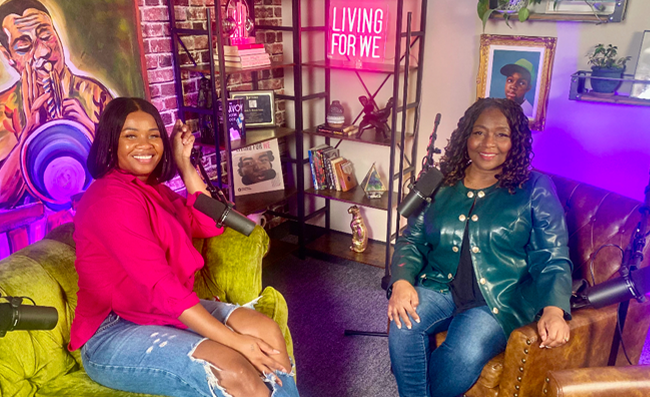
Welcome to Living for We: Keep Your Head Up. There are so many mothers, fathers, family members who've lost one of their loved ones to gun violence. And Myesha, this is a tough one because today we're talking to two moms who've lost their babies, their children, to gun violence.
Myesha Watkins:
It's so hard being a mom because this is the reality for so many people. Despite where you live, where you shop, where you worship, where you have fun – that at any moment, any one of us can be a victim of gun violence. But to lose your child, rather zero or a hundred, it's still a space that no parent will ever want to feel.
Marlene Harris-Taylor:
And as a mom, they’re still your baby. Whether they're eight-years-old, nine-years-old, 20-years-old, they're still your baby.
And we’ve talked to two moms. One mom, her child was sitting in the car eating an ice cream cone, just minding her business on a busy afternoon, got hit by a stray bullet.
The other mom, she lost her son. He was older, but he was also in a car with other young men. And he was the only one in the car that got hit with a bullet.
Myesha Watkins:
The reality is, is that we're losing people and children to a preventable, very senseless act of violence. There is no way that we're having this conversation over something that is preventable. Handle your conflict in a way between you two instead of putting innocent bystanders in a way of losing a life, a life that hasn't even started.
Marlene Harris-Taylor:
So, Marshawnette, how long has it been since you lost your baby?
Marshawnette Daniels:
Ooh, it will be seven years this year.
Marlene Harris-Taylor:
Seven years, I can't believe it's been that long.
Marshawnette Daniels:
It seemed like yesterday.
Marlene Harris-Taylor:
It does. Do you mind talking about what happened and how she died?
Marshawnette Daniels:
Well, my son was boxing, and I was going to pick him up and I was like, “Hey, you guys, I'll be right back. Let me go run in here and get your brother.” I was literally at the gym, like standing at the door, like talking to the coach.
And I'm telling my son like, “Hey, come on, let's go.” And we were talking about them leaving for the weekend or whatever. And out nowhere, it was literally a minute and a half, all hell broke loose. And the only thing that I knew is I had to just get down.
When I say it seemed like it lasted so long-
Marlene Harris-Taylor:
Bullets were just flying.
Marshawnette Daniels:
Bullets was just flying. And it seemed like I could just hear like ricocheting off a glass. And so, I lightweight tried to jump up and I was like my kids. I knew my son, he was up under the ring, but I was like by the brick and the bullets was just flying, I thought that they were coming in the gym, so I eased my way by the brick.
And so, I tried to get up to run outside. But the coach snatched me down to keep-
Marlene Harris-Taylor:
To protect you.
Marshawnette Daniels:
Yes. And so, it stopped, but before … I couldn't even get up off the ground like long enough before my oldest daughter was at the door and she had this look in her face, and I just looked and she was like, “They shot Saniyah.” And I was like, “No.” So, I ran out there and my baby was in my backseat.
Marlene Harris-Taylor:
And your oldest daughter was in the car, and really saw the whole thing?
Marshawnette Daniels:
She saw everything. All I know was a car that came by, as he came by the guys, they were like at the corner and they began to shoot at them. So, the guys on the street began to shoot back-
Marlene Harris-Taylor:
At the people in the car?
Marshawnette Daniels:
At the people in the car. Two bullets went in my car, one almost hit my oldest daughter. And so, like I said, I don't know what the issue was. And I walked right past the guys. Like I couldn't even tell you how they looked because it was just a normal day on the street.
Myesha Watkins:
I've been preparing for this episode, and I didn't know how I was going to show up, and I just want to say thank you for your bravery and sharing your story with us because it's not easy. But I know your sharing will help other people. And I just want to say thank you.
Marshawnette Daniels:
Oh, you're so welcome.
Shanika Jackson:
You want some tissue?
Marshawnette Daniels:
Yes, please. Please don't cry. I don't want to cry.
Marlene Harris-Taylor:
It's okay, if you want to cry. It's alright. But one thing that, I don't know if you want to call it a positive or not, but you did get justice. I mean, they found all of them, who were involved, and as you said, they're all in jail.
Marshawnette Daniels:
They caught everybody within a week. And then even one person turned himself in. And these were babies. They all could have been my sons, every last one of them. And people don't understand, I was disappointed. It's not so much … I was mad, I was hurt because that's my baby. Let me be clear, that's my baby. That was my love, she was everything to me.
I was disappointed in the parents. I was with all my children, where were you? Because your son had the same opportunities as my son. The gym is right there.
Shanika Jackson:
How old were these young men?
Marshawnette Daniels:
Oh, baby, they was like 16 and 17. So, they all were around the same age, but they all got charged as adults. They all got bonded over, I was cool with all that. And at that time, I don't talk like that, but at that time, I would be in court, I wanted all to smoke. I'm going at the mamas telling them, come on. I even told one mama I would throw you off this ninth-floor window.
Myesha Watkins:
The mamas who came to court?
Marshawnette Daniels:
Oh, yeah. Because that's how I was feeling. Like that thing that you birth caused me so much pain. It's because of you that I'm in this much pain. If you would've been doing what you were supposed to do, being where … you here now, but where was you at then?
So, that was my … and at that time, I was angry. I've matured a lot now. And so, I know what it's like to be a parent. And people would say, “Oh, you know, being a single mom …” miss me with that because I did it.
I wasn't always single, but I'm saying my son, “Oh, I was not going to let my son be another statistic in the streets.” So, therefore, at the age of eight, whether you wanted to or not, you're going to the gym. Because boxing, regardless of what people think, it's great for boys. It's a discipline, because it makes them weigh the pros and cons of life.
So, if he's in that ring, if he throw a certain hit or he move a certain way, there's a counteract. You know what I mean? So, but that's the same thing that happens in their personal life. My house for me was the safe space, but what I was pushing for was parents to be held accountable. Now, there actually is a law and a book about it, but they're not utilizing it. Nobody's making them utilize it.
In Cleveland, you can actually like sue the parents up to $10,000. Because I always say had your child not shot back and just retreated, my daughter would be here. You understand what I'm saying? And it could have been more casualties. It was other people babies. It's cars riding by, we're talking about the busy street of Lee Road. What were you thinking? You did not weigh the pros and cons of life.
So, the little kids that was in the front of the gym, that didn't matter to you. And you guys were on video.
Marlene Harris-Taylor:
Myesha, what do you know about the Euclid Law?
Myesha Watkins:
So, the Euclid Law is like the Parental Accountability Act or law that council passed at the last year, but I think it was voted in at the top of the year. And basically, a parent has three strikes, like three strikes and you’re out. Three strikes and you got to pay $500 if your kid is doing some type of illegal or criminal behavior in the community.
What I do think that will happen because of this law, is one Euclid families will start migrating back to the city of Cleveland to help get back to a community of an inner ring suburb. Or families will just tell their kids that they can't live with them, which will also push kids back into the street. That will increase childhood homelessness. It will also increase community violence. More robbing, more stealing to get their needs met. So, I do think that it is a lot to hold parents accountable.
And then to counteract to that is that it's parents that say, “I'm trying to exhaust all of my options. The only time that I get help is after the fact. Once my kid does something in the system, you all give me all of these resources, but when I'm pleading to y'all that I need help on the front end of it, people are telling me that they can't help me or there's no opportunities.”
But I do think that it's holding parents who are a little lax, who are that parent that our friends and may not prioritize being parents, just providing and allow the streets and programs to raise their kids, that this will be a wakeup call for them. Because $500 in this economy for anybody is a lot of money.
Marlene Harris-Taylor:
Yeah. Absolutely. Well, Shanika, I want to bring you into the conversation because you didn't get that justice in court.
Shanika Jackson:
No, I didn't. Not yet.
Marlene Harris-Taylor:
For your son? Not yet.
Shanika Jackson:
It's coming.
Marlene Harris-Taylor:
It’s coming. Okay.
Shanika Jackson:
God has the final say, it's coming.
Now, it's a little bit different than her situation. My son was 20-years-old and that was Demetrius. I know I'm not going to sit up here and say my son was perfect, but I know the type of parent that I was, just like she was saying, I know the type of parent that I was.
My son was not raised in the streets, we didn't struggle. I always made sure that my kids had everything that they could possibly need. He was actually a little spoiled. He wasn't from no projects. He wasn't from the hood, but he wanted to be, you know what I mean? Like he wanted to be something that he wasn't.
Marlene Harris-Taylor:
So, he was kind of drawn to that, even though he wasn't brought up in it?
Shanika Jackson:
He was drawn to the street life because for a long time, he was my only son. He was 16 when I had his little brother. So, basically, he was the only boy for a long time. So, I coddled him just a little. But I was always very stern with my kids, you know what I mean?
I made them go to school, made them get good grades. They grew up in a two-parent household. The kids didn't want for anything, you know what I mean?
Marlene Harris-Taylor:
So, it wasn't that stereotype that people think about the single mother, blah, blah, blah.
Shanika Jackson:
No, I never considered myself a single mother. No, I wasn't with his dad, but his dad was there.
Marlene Harris-Taylor:
In his life, yes.
Shanika Jackson:
In his life, I wasn't a single mother. However, I still, to this day, I don't know why my son did a lot of the things that he did, but most of the stuff I didn't even know about. And we was just … you guys were just talking about how the parents should be held accountable, that right there is a double-edged sword right there.
Because it's like some of these parents really not … they don't have no idea what's going on. Like me, here I am thinking, “Oh, my baby's so sweet, do this face look like it would do anything wrong?”
Marlene Harris-Taylor:
No, it doesn't. He's so handsome.
Shanika Jackson:
Yes. And it wasn't, it was like … I remember it was 2020, a friend of his passed away, was killed by murder. And he just changed, because he was my sweet baby and my boy, like that was my baby. He did whatever I asked him to, he was a good boy. But in 2020, he started to change, started to get a little flippy at the mouth.
And I'm just looking like, “Who do you think you're talking to like that?” You know what I mean? So, then he's like, “Okay, well, I just need some space away from the house.” So, I'm thinking, I'm like, “Okay, yeah, my son just hanging out, he a good boy. I don't got to worry about him. And might smoke a little weed here or there, but I don't have to worry about him into stuff.” That wasn't the case.
And it was like I get upset sometimes because other people knew. Other people that knew me knew the things that he was getting into, never told me nothing. But when I was getting glimpses of it or people was telling me stuff, “Oh, I went down there and I drag him back by them dreadlocks.” I say, “Come on here. Get from down here. What is you doing? Why are you calling yourself this person?”
Marlene Harris-Taylor:
You actually went and got him?
Shanika Jackson:
Oh yeah, I went and got my baby. Oh yeah.
Marlene Harris-Taylor:
And took him home.
Shanika Jackson:
I grabbed a belt too. I'm like I don't care how old you is, I don't care.
Marlene Harris-Taylor:
For a 20-year-old man, I love it.
Shanika Jackson:
I whooped him. I whooped him at 16, 17, 18. As long as you was living in my house under my roof, you was getting a whooping when you defied me. So, I was asking him like, “What's going on?” He was just saying, “Nothing for you to worry about Ma, I just got a little beef with these guys.” And I'm like, “What guys? Tell me, what's their names? We can try to do something about it.” He was like, “No, Ma, I got it. It ain't nobody there, ain't nobody.” You know how these kids are.
So, I'm just like, “Okay.” And I just noticed he just got even worse. Things just started to get worse with him. He started lying a lot, he just started like different things. Like I would get packages from my house, and I don't care how old you is, if you get a package in my house, I'm opening it and I want to know what's in it.
Marlene Harris-Taylor:
I want to know what's coming to my house.
Shanika Jackson:
Things that I was finding in those packages, I was like, “You can't be here. I don't know what you got going on, but I got other kids here, son. I love you to death, but I got other babies here. What is going … why you got this stuff sent to my house?” He said, “Ma, it's for protection.” I said, “Why do you need a gun for protection? Is somebody threatening your life?”
So, it was just little stuff. And I'm just like, “Okay, well maybe he needs the gun for protection.” It is bad out here, people getting robbed, people getting … so I was okay with it. At first, it wasn't really nothing I could do about it because he was grown. There was nothing I could do about it.
It is not like he was going out getting in trouble because he wasn't, the boy had a clean record. He wasn't getting in trouble. He wasn't getting arrested, but he was hanging around his friends. Every day, I preached to him and I called him, and I called him and I text his phone every single day. I say, “Are you safe son? Are you safe? I seen someone on the Cleveland Remembrance Page, are you safe?” He like, “Mom, I'm okay. Stop doing that.” If I didn't hear from him, I reported him missing.
I'm like, “You ain't answering my phone calls, I'm going to go to the police station.” Then he'll call me like, “I'm not missing.” It was just like I was on him, and something happened in 2022 and it just completely turned him dark.
Marlene Harris-Taylor:
Do you know what it was?
Shanika Jackson:
Yeah, my niece was murdered. Adriana Jackson. She was murdered while laying in her bed. And she was only 14.
Marlene Harris-Taylor:
I remember that.
Shanika Jackson:
Yeah. So, that right there just made him … it's certain circumstances around that. I don't know what's what. But that made him very angry and just made him cold and dark. And then and I'm asking him, I said, “Well, if you know anything about this, you need to say something.” He was like, “I don't know nothing about it.”
And he kept it at that. He didn't say anything. So, everybody in my family was trying to get our lives back to normal. And that particular day in June, it was June 19th, Juneteenth, I get home that night, it was probably like 8:30, 9 o'clock. And I remember being so tired, just exhausted. But I had a really good day, but I was just really tired.
Went upstairs, I laid down across my bed, and didn't even get a chance to take my clothes and shoes off, that's how tired I was. And all I just heard was a screeching scream. It just keep playing in my mind over and over. And she was just screaming and I'm just jump up like what's going on?
She was like, “Ma, Ma.” And she like, “Come on, we got to get to the hospital.” She says, she said Meme (that was his nickname, Meme). She said, “Meme got shot in the neck.” I froze, I don't know what I was thinking. Like I completely froze. And then I started walking in a circle.
I don't know what I was looking for. It was just like I don't know if I was having an out of body experience. I was walking in the circle in my bedroom, just walking in the circle. And I'm just like, “What?” My daughter ran upstairs, she was like, “Ma, why you not getting your keys?” I couldn't speak. So, she grabbed the keys, and she pulled me. She said, “Come on, we got to get to the hospital.
So, I get to the hospital, they say, “Well, we got your son in here, and we working on him.” I want to say maybe 30 minutes later, that heartless, heartless doctor came out and I could just remember her being like how could you tell somebody … how you just be so happy and chipper when you coming to tell me that my son didn't make it?
She comes out, she says, “Oh well, it's okay. Come here.” Because I'm backing away from her. She's coming towards me, I'm backing away because I'm just that scared. I'm like, “Please, please.” But in the back of my mind, I already knew. I felt him. I felt my baby. And I knew that he was no longer here but I didn't want to hear it.
And I walked out of the hospital, and I could just remember it was raining and I just started walking. Left my truck, I started walking. And my family members, they come, I'm just like oh no, I couldn't even crack a tear because I'm like oh no, this ain't real.
So, then I'm starting, I'm getting bits and pieces. They run through some names. They telling me what happened. They said that he had got into it with some guy, the guy that they claimed that was the shooter or whatever, got into it with him a day before or something like that. They saying that … not the day before, earlier that day. And they say words was exchanged, however, whatever, and they let everything go and then they all went their separate ways.
And so, my son was at a barbecue over on 105. And supposedly, the guy or guys, because I keep hearing it was one I keep hearing, it was multiple, I don't know. They saw him jumping in the car that he was … my son was using somebody else's car, jumping in the car that he was using, my son and his friends, and they was riding down the street. And what was told to me was that the guy was sitting down there waiting on him and as he drove, they shot at the car.
Nobody wants to be labeled as a snitch, I understand that. But this is my child that was laying down here. This is his blood laying down here in the street. And he wasn't doing nothing to nobody. I want to know, I still to the this day … I don't know why my son is gone.
I don't know what he did him and these boys was into it about, I don't know. I want to know why you killed my son. Why did you take my life from me? Why you take my baby away from his daughter? People that loved him, he wouldn't have did you that way, whoever you are, or you know who you are, he wouldn't have did you that way. He spared you and you still took my baby away from me. I still don't know why, I'm sorry.
Marlene Harris-Taylor:
No, don’t apologize.
Shanika Jackson:
I still don’t know why. And at this point, I don't even care because what is it going to solve? To know the why? What is it going to solve?
Marlene Harris-Taylor:
You don't think it would give you a sense of, I don’t know, closure, yeah.
Shanika Jackson:
You know what would giving me closure? Justice.
Myesha Watkins:
Shanika, one of the things that we talk about consistently throughout the podcast is the fact that nobody can be arrested for disrespect, but people lose their life for disrespect all the time. That one conflict that brings up a feeling of embarrassment or lack or scarcity, they respond with a firearm. That they rather not feel it or process it or talk it through, they want to end it, and not thinking about who, whoever's on the other side.
I oftentimes say like, “It's bigger than a bullet.” Because after someone life is … somebody's murdered, like the parents are doing the leg work. They're advocating, they're crying, they're still grieving. And I remember us talking, it's just like every life loss for a mom or a family member, even if you're grieving and you're doing well – you see the Cleveland Remembrance Page or the news and it's just like another baby, another person, another loved one, another family, another community.
Shanika Jackson:
Every single time I'm like, “Damn, maybe I should reach out to that mom.” Or maybe I should try to help … my cousin, her name's Alexis Jackson, she has a grief group, and she is so strong. I definitely have to mention her.
She is so strong. Her daughter, that's Adriana's mother, she's so strong. I don't know where she gets it from because baby I be ready to pull out every strand of hair up underneath this wig that I got. But it was her, I promise you it was her that she brought me back, she brought me back.
Because it was times I wouldn't get up out of my bed, I wouldn't comb my hair. She like, “Come on now, girl, you starting to stink. Let's go get up, come on, we about to barbecue. We going to sit out here. We going to play Mitch and Avery's favorite music. We going to do this.” And I'm just like, “Where do you get this from? Where do you get this strength? Because I am literally dying inside.”
Myesha Watkins:
Now, I have a question for Marshawnette – hearing another mom story, you both sitting on the couch together, what advice would you give to her?
Marshawnette Daniels:
It's a moment-by-moment thing. It's like a second by second. It's going to be a long time before you come out of this thing, and I always call it a bubble because it's your bubble.
Shanika Jackson:
I call it a hole, a dark hole.
Marshawnette Daniels:
But if we go spiritually, it's the pit. You know what I mean? So, it's being in that pit and in that pit, it's everything in that pit. It's depression, it's suicide, it's rage, it's everything it's in that pit.
And for me, I would just say, I always call it healing healthy. And so, I applaud you for doing the footwork for your baby. That's amazing because … and I feel so bad. So, when I hear things like this, because I had went to this thing and it was called Survivor's University, and I have never been in a room with such pain.
It was so much pain in this room, it was just overwhelming. And it was people like you and me. And the only thing like that I think for me that bothers me is other people's babies didn't get the attention that my baby did. And I understand, I've had moms come to me and say, “My baby was 30.” It doesn't matter, that's still your baby.
Shanika Jackson:
That's why I'm here today. My son was 20 and he no longer has a voice, but I'm his voice. I'm going to always speak my son's name, I'm going to always keep his memory alive. I don't care if they only did one new segment on there, I'm going to advocate for my son for the rest of my life.
Marlene Harris-Taylor:
But you bring up a really important point that certain things will resonate because your daughter was so young and she was so beautiful and so vibrant, and it spoke to people, but then your son, people are like, “Well, what was he doing?”
Shanika Jackson:
Exactly. Honestly, I really can't answer that because to this day, I'm still finding out things I never even knew about my son. They said, “He did what? Like now why would he do that?” But I also hear way more good than bad. He was a good kid, he just fell into the wrong crowd.
And a lot of this stuff with these young kids, and I'm not going to hold nothing back – a lot of this has stuff to do with social media. I heard that my son and this other boy or boys was beefing on Instagram, Instagram.
Marshawnette Daniels:
And a lot of this stuff is really ego. It's ego and it's pride. And so, as our children are coming up, like I talk to my son, my son, he, he'll be 21 next week.
Marlene Harris-Taylor:
How's he doing?
Marshawnette Daniels:
He's doing good.
Myesha Watkins:
Is he still boxing?
Marshawnette Daniels:
He's still training. And see, and that was another thing; people don't understand that when they take our babies from us, one death causes so many other deaths. It's the small deaths … you understand what I'm saying?
Myesha Watkins:
The grieving process.
Marshawnette Daniels:
It's the small deaths. Like my son was going pro, he's no longer going pro.
Myesha Watkins:
So, I think people, when they think about grief, automatically, they think about loss of life. But you can grieve anything.
Marshawnette Daniels:
You can grieve anything.
Myesha Watkins:
That tragic experience that happened to his sister and your baby that day when he was doing something that he loved to train for something that he worked so hard for, it is associated with the loss of life. So, you can grieve other things that means a lot to you in addition to the loss of life.
Marshawnette Daniels:
And people don't understand that, so I'm glad that you said that. And like-
Shanika Jackson:
Our lives literally stop when we lose our children.
Marshawnette Daniels:
Everybody else keep going, and it's like, “Wait a minute, hold on.” But it's like I get it because I watch friends life go on, I watch everybody else, but when I'm talking about the small deaths and the other deaths, it's like my mom lost her daughter. She didn't only lose her granddaughter because now, I have to live this new normal, and who I was before the tragedy, that's not who I am.
So, I'm walking around exactly, trying to figure me out. I'm 47 now, so now, I'm trying to figure out who in the hell am I, what is my purpose? You understand what I'm saying?
Shanika Jackson:
I definitely understand.
Marshawnette Daniels:
And what people don't know, I'm a whole minister. So, my whole faith, my foundation, everything was shaking. I've been in therapy girl since day one. I gave them people hell, I gave everybody hell. Oh, I gave everybody hell because my baby, we talking about a four feet something, 78 pound and you hit my baby in the back, like come on now.
So, you don't know what it's like to have to … I'm a nurse. We ain't talking about no nursing assistant, no, I'm a real nurse, went to school. I held my baby. I watched her tongue protrude out her mouth, I watched her eyes turn grey, and I watched my baby swallow for the last time. I knew but I held onto the word of God.
The thing is, people don't understand. We have an umbilical love for our children. This is not nothing that a father could feel, this is an umbilical love.
Marlene Harris-Taylor:
A mama’s love is a different kind of love.
Shanika Jackson:
They grew inside of us, we know our babies.
Marshawnette Daniels:
No matter what I do, you can open me up, I still can’t reach that pain. My pain always stays in my spirit, my spirit is wounded. Don't get it twisted because I get up, I get myself together because that's what I'm going to do anyway.
Shanika Jackson:
It took me a long time to even get to this point. And I'm actually, I'm starting to get back to myself. I'm starting to be happy again.
Marlene Harris-Taylor:
Are you doing therapy?
Shanika Jackson:
Yes. Oh, definitely. I got to, I would be going cuckoo. You all be seeing me on the news next. But yes, I attend therapy sessions, grief counseling groups, whatever it is I can do. I talk to people, I let my pain out.
I don't care if it's three o'clock in the morning, I will sit there and cry and look at pictures. Anything that I can do to get it out. You can't keep that in. But like she said, that's a never-ending pain. Your kid was a part of you. And then it's to think like I got to go through the rest of my life without him.
Marlene Harris-Taylor:
I'd love to know from your perspectives what you think are maybe some solutions to what Myesha calls this disease of gun violence.
Shanika Jackson:
These kids need therapy. And I'm going to explain something. This is why I asked you, how old were these young boys? We've all been young, we've all been teenagers and everything, and we've all just did something out of hotheadedness, like not even thinking – I know I have. It's just like, “Oh, I'm going to do this and I'm going to do, I don't care. Or I know everything, I'm not going to listen to my parents. I'm not going to do anything.”
These kids are going through the same thing that we're going through or except they got guns to pick up. These kids lack the brain function, they're not fully matured. And young boys, they mature slower than young girls. These are kids, they're not fully aware. I mean, they are aware, but they have no self-control. They can, but-
Marshawnette Daniels:
Yeah, but I think as what we have to do is we have to create (and this is what I think that people are missing) a safe space. We have to create a safe space for men to say, “I'm scared.” We have to create a safe space for a man to say, “I'm sad.” We have to create a safe space for them to cry.
Because as even I'm growing up, they're taught not to cry. See, when my son cry, everything stop. Because that's a man and something is wrong. If my husband cry, everything stops, something is wrong. But we don't create the safe space to say it's okay to feel your emotions.
Shanika Jackson:
It's okay to cry till you tell me what's going on?
Marshawnette Daniels:
It’s okay to hurt, guess what? If your friend got … like my son, one of one of his friends, something happened, and it broke my baby again. But I created that safe space, but I've always done that with my children.
Create that safe space. Listen, I got on the floor and I held my baby. It don't make my son less of a man because he cry. It makes him more of a man because those emotions, he's able to feel. And ain't nobody going to make my son feel like he's less of a man because he cry.
You can cry, this is a safe space. I'm your mama. If don't nobody else got you, I got you. And when my baby break, oh baby, I'm right there. And I'm getting my son … I don't care what's going on with me. I'm getting my baby off that floor. So, when you talk about solutions, that's a solution, creating a safe space.
Marlene Harris-Taylor:
These two moms, they're in different places, but they're both still grieving, very much the loss of their children.
Myesha Watkins:
We had many episodes sitting in these same chairs. I would say this was probably one of the hardest and most emotional episodes to sit in. Sometimes when I'm talking to people as a counselor, as a friend, as a mom, I just envision myself in that situation. And sitting in this chair thinking about losing my children, I struggled a lot.
Marlene Harris-Taylor:
It's just so hard to imagine what they're going through, and the grief, and the pain. But we're getting ready to talk to someone who is in a similar situation, but she's a counselor herself and she has some advice.
Myesha Watkins:
Oresa Napper-Williams, she started a program called Not Another Child. She is like my national auntie, I met her in doing this work. And I think from meeting her, I was better equipped to be an executive in this space because I had the heart and mind of what a survivor goes through and continues to grow through.
Marlene Harris-Taylor:
After hearing these stories of grief, we know that there's so many other people out there going through the same thing in Cleveland and beyond. So, we didn't want to just end with that, we want to give people some hope and some advice on how to make it through to the other side.
Myesha Watkins:
Absolutely. Turning your pain into passion, and not just stopping there, but helping other parents, mothers, fathers, guardians, friends and siblings journey right alongside of you. So, the strength that it takes to every day tell your story, to encourage someone else to let them know that it is good grief on the other side. I'm excited to listen to her.
Oresa Napper-Williams:
We all know that gun violence, although amplified on the side of the shooter, it devastates families on both sides. When the media gets a hold of the story, they usually talk about the shooter and they'll maybe have one or two lines, if that, about the actual victim or the surviving family members.
I found in my travel that with one victim, it's at least five family members that are directly impacted by their death. Whether it's parents, a sibling, some in their older age may have a spouse, some have children. And so, because of that one person's actions, at least five people are affected. And so, that's how I talk about the effects that it has on the family.
Myesha Watkins:
How did you start your workbook, Good Grief around there? And how did you get to that space where you can put the word “good” in front of it?
Oresa Napper-Williams:
How can grief be good? The definition of grief is a deep state of that place that you encounter after loss. And I've chosen to turn it into a deep state of comfort, a deep state of just rejoicing and having solace in what was, opposed to focusing in on what will never be.
My sons were and are a year and a half apart. And so, everything we did was together. Even when they came to an age where it was like not the three of us anymore, it was just the fellas. So, they were always together, except for that week, my son was murdered.
And so, I've always been so grateful for that, and grateful that I still have a son, grateful that I was given 21 years with this incredible human. And that's what made Good Grief so special because a lot of people look on the other side of grief.
Marlene Harris-Taylor:
People want you to hurry up and get over it.
Oresa Napper-Williams:
Absolutely, and it's not something that you get ever get over, but you get through it, and you lose so many people that you love in this transition because you're never that person that you was.
And so, when we talk about recovery, I won't be the Oresa that I was on August 6th, 2006, the day before my son … I'll never be that person again. I can recover now what is there for me in this portion of my life, and you lose people in that place.
Marlene Harris-Taylor:
How do you continue after the loss of a child?
Oresa Napper-Williams:
It's by giving yourself grace daily. I have a friend that posted something the other day, like three people dying at once. We always think, oh, death comes in threes, and then a friend commented on his post, “I hate death.” And I text him and I said, “Do you really hate death? Or do you hate the grief that comes after it?”
Because we all know that death is inevitable. We all are going to die. I'm sorry, we are just not going to … sorry to bust anybody's bubble. I had to realize that it's not so much death, but it's the grief that one experiences thereafter.
And so, giving myself grace daily, to just sit back sometimes if I have to. To not have to move and navigate life the way that life thinks that I should, because this is a traumatic state. It is trauma that comes along with it. And we, in our communities, especially black women, we should have had PTSD before they had that for anything else, for the army, the navy, anybody. We have been prone to PTSD.
Marlene Harris-Taylor:
We've experienced so much loss, black women here in the Cleveland area and across the country.
Oresa Napper-Williams:
I always say the layer of trauma that my son's murder has given me is here, but it's covering up the layer of insecurities, the layer of raising two sons by myself, the layer of poverty – all of those layers are under it, and that's what we have experienced as black women throughout our lifetime.
And a lot of times, we only deal with that layer that's prominent at that moment. But it's all about, that's another thing, going back and digging deep into those layers, because a lot of us mothers that lost children, we have resent for where our relationships was at that time. So, it's about forgiving yourself, and living life without regrets for your next child and for other relationships.
Marlene Harris-Taylor:
Did you go through that? Did you blame yourself?
Oresa Napper-Williams:
Absolutely. I had just kissed my son that morning. Just kissed him that morning because he was stuck in New York because he left his keys at home. And so, he hit me that morning and I'm like, “Where you at?” And he's like, “Oh, I spent the night out cousin's house in New York. Can you meet me on a train for my keys?” And I said, “Sure.”
I went to the train station, I waited about an hour for him, but I waited, and thank God I waited because that was my last kiss, that was my last everything. And he got on the train with me, and he was getting off and he said, “I'm going to see about a job.”
He got off the train, but after he went to see about a job, he went to check on a family member, and I'm like, “Damn, I should have just left the key at home. I should have went ahead to my office and he could have came and hung out.” But I had to realize that we are all appointed a time of death.
That was his day, and you always have questions about it, like why so young? Why this? Why like that? It's all interconnected.
Marlene Harris-Taylor:
And there's no answers really to those questions.
Oresa Napper-Williams:
Well, something in my book, I say, time doesn't heal, it reveals the why. And so, my answer is the work that I'm doing now, because the work that I'm doing is my purpose in life.
Marlene Harris-Taylor:
You say that black women are the key to healing the community. What do you mean by that?
Oresa Napper-Williams:
How many people do we have that come and lay on our bosom that want guidance? Whether it's a black man, whether it's our black children? Whoever it is, it is key because we have the wisdom because of all of the layers that we have. We have that wealth of knowledge and wisdom, and love and empathy.
Because you can only have empathy if you … empathy is not a learned trait. You can only have empathy if you have been in that space and that place. So, how I feel for mothers, teenage mothers that have children and this, that, and the other, may not be how another black woman feels for them. So, my experience plays a different role. And so, that's why I think my sisters are powerful, black women. What? Nah, they are the key.
Myesha Watkins:
Mothers and fathers and families who are grieving, who are not at the point where they see their grief as being good, what would you tell them?
Oresa Napper-Williams:
I would tell them to identify three things that your loved one left you with. Three good things. Whether it was that hug that only they knew how to give, whether it was how they said, “Ma!” If you could remember the smile, if you could remember how they used to bash you because my sons will be like, “Ma, you faking.” Different little things, their life and their memory should not evolve around one day and one circumstance.
So, just do that for me. Think of three things that they have left you with.
Marlene Harris-Taylor:
Did you use meditation to help yourself through the grief? Because I know that you have tips of meditation. Meditation tips for people.
Oresa Napper-Williams:
I used meditation, but I called it more mindfulness. Whether it’s taking mindful minutes the first thing in the morning when I get up, not reaching for my phone, but just laying there and getting my mind right for the day before I put my feet on the floor or anything – if I have to break away during the day and do it as well.
So, it can be incorporated as meditation or as mindfulness. Just being mindful that, okay, at this point of the day, I'm becoming overwhelmed, and what I need to do is now meditate or have a mindful minute or something to that effect.
But I've tried to incorporate those things even once a week, just relaxing, whatever that looks like. Taking a nice hot bubble bath, reading a chapter from a book, whatever that looks like. And I think it's hard when you need the support that you're giving as well.
Marlene Harris-Taylor:
For the people who want to help the person who's grieving, they often don't know what to do. If a mom or a dad has lost a child, what can their community do to help them?
Oresa Napper-Williams:
And so, I think a lot of times, we ask when the person does not even know what they need as well, I'd go into a house and identify, okay, this mom don't have no food here, and it's three children. Even if she do have food, the last thing on her mind is to cook right now.
And we used to do that back in the days, we used to show up at houses with food. I also think that being present in the moment, looking at who they have there, whether it's other children, it could be their mother, and seeing like how you can rally to get them the additional support that they need.
Because a lot of times, we show up as support, but we got to bring in the troops because with that, it's really all hands-on deck. Sometimes I go to houses and it's like stepping over the blood of their baby to get in the house. So, then you got to take your bleach and stuff and get that blood out.
And so, just being able to come out of your comfort zone, and if it's things that you don't want to do, calling in the troops once again because at that time in that space, the family should be what's most important to you.
Myesha Watkins:
So, we just heard from three mothers who have lost their children to gun violence.
Marlene Harris-Taylor:
And each one of them, the journey is different and they're in different places. But you hear similar things as people are going through this journey, whether it's a mother, a father, a sister, a brother. Grief has several stages that everybody has to go through.
Myesha Watkins:
And it's a ripple effect. I think one of the things that the mom said is that every time a child loses his life to violence, my grieving process start all over again. Like can't you imagine?
Marlene Harris-Taylor:
Myesha, I wish we could say that there would never be another mother or father who had this same story, but unfortunately, we know that's not true in Cleveland.
Myesha Watkins:
It's not true for our entire country with the disease of gun violence happening at the rate that it has been.
Marlene Harris-Taylor:
This episode is dedicated to Saniyah, Andrell, and Demetrius.
Myesha Watkins:
May their memory live on. And we as a country, as a city, as a state, can eradicate the disease of senseless gun violence.
[Music Playing]
Ruth Ray:
Hey, good evening, Ruth Ray. Mental wellness, mental illness and gun violence, I truly believe are one and the same. My cousin, her brother, mistakenly shot. She lived just until February 4th, 1991.
Unfortunately, my aunt lost two children that day: her daughter and her son. His mental health wellness went away. He became mentally ill and struggling since that day. But as we continue to live on and her spirit lives on, every now and then, he comes back just to remember the amazing person his sister was.
So, when I say again, mental wellness, mental illness and gun violence lives together. But it don't have to keep you from living a healthy and productive life. I live for the life and memory of Ashia Lori Jones, thank you.
Recent Episodes
View AllS2E11: Hope in Akron
Living For We: Keep Ya Head Up | S:2 E:11S2E10: The Cavalry Ain’t Coming
Living For We: Keep Ya Head Up | S:2 E:10S2E9: Hope in the Crossfire
Living For We: Keep Ya Head Up | S:2 E:9S2E8: A Second Chance
Living For We: Keep Ya Head Up | S:2 E:8
Hear More From Us!
Subscribe Today and get the newest Evergreen content delivered straight to your inbox!
Advertising & Sponsorship
Interested in sponsoring or running an ad for your business on an Evergreen Podcast? Contact us to get pricing and availability.