
Living for We, Season 2: Keep Ya Head Up
Every bullet fired creates two victims: the person who is shot and the one pulling the trigger. It’s a traumatic experience for both; the victim may lose their life, and the perpetrator may lose their freedom. This season, we're asking what can be done to end cycles of violence in cities like Cleveland, Ohio when the shooters value their reputation over their own lives and see innocent bystanders as collateral damage.



S2E6: Feared and Revered
| S:2 E:6Chairman Fahiem, known to some as Antoine Tolbert, is a well-loved figure in parts of Cleveland — but right now, he’s fighting to stay out of prison. As the leader of New Era Cleveland, Fahiem works to empower communities hit hard by gun violence. He and his team are known for patrolling neighborhoods, often armed, hoping their presence can help keep the peace.
City leaders have praised Fahiem’s work, and a major Cleveland foundation recently awarded his group $150,000 to support their violence intervention efforts and train an 11-member Trauma Response Team.
But at the same time, Fahiem is facing serious charges. The Cuyahoga County Prosecutor’s Office has accused him of extortion, claiming he threatened a local convenience store owner and asked him to pay for “protection.” Fahiem strongly denies the allegation and speaks out about it on the podcast, sharing his side of the story and promising to keep leading his organization — even as he *faces the possibility of 15 to 20 years behind bars. The Cuyahoga County Prosecutor’s office declined an invitation to share their perspective on the court case. A spokesperson said they do not comment on current cases and their indictment of Fahiem is their statement.
We’ll also hear from a Cleveland State University student and a Newburgh Heights high schooler about how gun violence casts a constant shadow over teens' lives, whether they’re in the classroom or simply trying to enjoy themselves.
View our full list of resources here.
Where to Listen
Find us in your favorite podcast app.

Voiceover:
Living For We is part of the Connecting the Dots between race and health initiative from Ideastream Public Media made possible by generous support from the Dr. Donald J. Goodman and Ruth Weber Goodman Philanthropic Fund of the Cleveland Foundation, and made possible in part with support from Enbridge Gas Ohio.
Marlene Harris-Taylor:
Warning, this episode contains descriptions of violence.
Myesha Watkins:
Viewer discretion is advised.
Chairman Fahiem:
We stand in solidarity and realize that this is what they're afraid of. Look around, look at the police presence, we're amongst friends, family, allies, and enemies.
Myesha Watkins:
Chairman Fahiem, also known as Antoine Tolbert, has shown up for many families in the city of Cleveland who's been impacted by violence, who love him for always being dependable.
Marlene Harris-Taylor:
At the same time, he's facing charges from the city of Cleveland of extortion and may face a long time in jail.
[Music Playing]
Marlene Harris-Taylor:
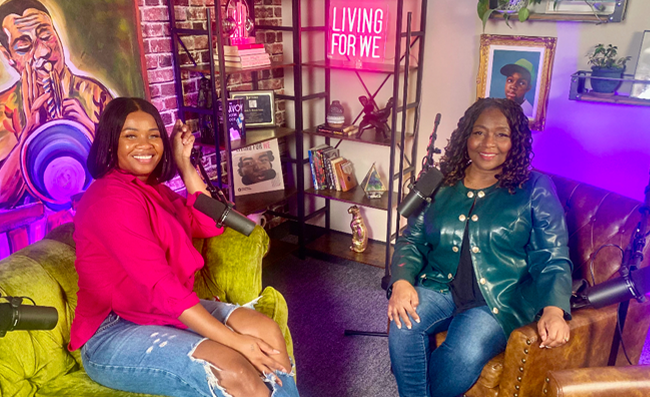
Welcome to Living For We, we're so glad that you came back to have this conversation with us. Hi, Myesha.
Myesha Watkins:
Hey, how are you?
Marlene Harris-Taylor:
I'm good, I'm good. Our next guest, Myesha is Chairman Fahiem, also known as Antoine Tolbert. He has made his self-known in the Cleveland community and landed in the media a little bit.
Myesha Watkins:
The way that he shows up in community for black people and hold people accountable to the safety measures that he believe is possible for our community is amazing, and sometimes can allow people to fear him as well.
Marlene Harris-Taylor:
He runs an organization called New Era Cleveland. New Era is a national organization that started in Detroit, and it's an organization that fashions itself to be similar to the Black Panther movement of the 1960s and 70s. They believe in the community, black people showing up for ourselves and taking care of our community, and that's what he believes in doing.
Myesha Watkins:
And holding people accountable who profit off of our communities and do not respect the people in our communities as well.
Marlene Harris-Taylor:
So, New Era Cleveland, they do patrols in neighborhoods with men carrying guns. If there are problems at local businesses like gas stations, like people fighting or people shooting, they'll show up there so they can bring a sense of calm for the neighborhood. I mean, sometimes they say they're doing what the police should be doing but you know.
Myesha Watkins:
But even in addition to that, they show up for families who will feel a lot more safe calling them, calling Chairman Fahiem than calling law enforcement. The chances of Chairman Fahiem coming up, coming to their home reduce the risk of somebody losing their life or going to jail.
Marlene Harris-Taylor:
And he calls himself Chairman because he's harkening back again to the Panthers, right?
Myesha Watkins:
Absolutely. And even some of his struggles is like when you are committed to the cause, you cannot do it without being attacked. And he is no stranger to that, and continue to overcome adversity and continue to put on for the people. And if you're watching this, the chant is, “New era, era, new era, era, era.”
Marlene Harris-Taylor:
Oh, I didn't know that was: “New era, era, new era, era.” Alright, I'm going to say that to him the next time I see him.
Chairman Fahiem:
So, we are a liberation movement, we are one of 20 plus movements nationally and internationally, and our focus is just uplifting impoverished and forgotten about and neglected communities. I was looking for an outlet, frustrated with the conditions plaguing our community, and much like a lot of folks, I was on social media being a keyboard warrior.
I participated in some local organizing events, but it didn't resonate with me in regards to what are we trying to accomplish? Protesting and rallies, making noise, but then there was the question after I would leave, and then what? What's the next step?
And so, scrolling on social media, I came across this movement called New Era up in Detroit, and I found value in the stance that they took in regards to what's required in order to get our communities back to a status of which we could be proud.
And just bringing back that humanity, and so when I saw that, it was like, “Okay, I need to be a part of this.” I was willing to travel to Detroit and they was like, “Nah, you could start right there in Cleveland where you are.”
Marlene Harris-Taylor:
So, you picked up the banner.
Chairman Fahiem:
Picked up the banner and ran.
Marlene Harris-Taylor:
And you did it.
Myesha Watkins:
And haven’t put it down since.
Marlene Harris-Taylor:
So, how many years now?
Chairman Fahiem:
Eight years now.
Marlene Harris-Taylor:
Now, sometimes, I've heard the word “panthers, black panthers” come up in relation to New Era Cleveland, the New Era Cleveland is sort of the modern Black Panthers. Do you see it that way?
Chairman Fahiem:
I do see a lot of similarities. Again, that's the foundation that we stand on. And again, much similarly to them, a lot of the trials and tribulations that they had to endure during that time, we’re facing some of those same magnitudes of scrutiny. And so yeah, I do see a lot of similarities. And then obviously, Chairman Fahiem and Chairman Fred Hampton, I did find value and embodying some of those characteristics for sure.
Myesha Watkins:
What are some of the challenges that you face with the foundation of doing amazing work that maybe dominant culture or even communities that we live and work and play in don't understand.
Chairman Fahiem:
With the non-profit industrial complex, a lot of community work can be perceived as a joke based on past experiences with leaders in the city of Cleveland in particular. And so, to see someone pick up that baton and step into this space and try to fill that void, people may look at you like, “Oh, you're chasing notoriety, or you're chasing the same thing that these other people before you were pursuing, you're not really here for the people.”
And I think that for me, the easiest way to break down those stigmas is my willingness to make sacrifices that people are not willing to make in today's society. So, that's how I go about really addressing some of that stuff.
Marlene Harris-Taylor:
Because you're financing this yourself.
Chairman Fahiem:
Absolutely. Yeah.
Marlene Harris-Taylor:
I remember talking to you and your partner Austria, and you guys told me that maybe you may get some donations, but a lot of times, you take money right out of your own pocket to do this.
Chairman Fahiem:
Do you really believe or have faith in what you're doing to that magnitude to where you're willing to say, “I'm going to take away from my family, my household, and pour it to my community?” And ultimately, at the end of the day, we realize that the success of our family, our household, is directly intertwined with the success of our community.
Myesha Watkins:
What are your thoughts around the disease of gun violence in the city of Cleveland, and then being a man, a black man who know his rights and also carry a gun?
Chairman Fahiem:
My perception is that this city in particular, Cleveland, Ohio, is not serious when it comes to addressing gun violence. It has no wherewithal, where to start, what is required, and what it actually takes to have an impact in regards to violence prevention in the city of Cleveland.
And again, much like we've seen with movements similar to New Era, there is something about a black man that is educated and that is confident and courageous that poses the greatest threat to systematic oppression.
Marlene Harris-Taylor:
But then on top of that, you are walking down the street open carrying dude. Now, you knew you were going to draw some attention on that, but I don't think you thought you were going to get all the attention you got.
Let's just talk about that for a minute. It's legal in Ohio to stand your ground or just carry because you want to, because you feel like it, right? And so, you walking down the street just carrying your gun one day and what happened?
Chairman Fahiem:
I was arrested under false premises.
Marlene Harris-Taylor:
That case ended up getting thrown out.
Chairman Fahiem:
Got thrown out.
Marlene Harris-Taylor:
But still, you had to go through that. That must have been tough.
Chairman Fahiem:
Looking back on it now, I can laugh about it, but in that moment, I lost a lot of opportunities, a lot of partnerships that I had on the table, my reputation, character assassination, but again, just the love from community, like was just the one thing that made me be like, “I'm doubling down on this.”
Even in that moment when I was being arrested, folks in the community were there on the scene saying, “We going to make sure that you all don't hurt him. We know the history of law enforcement in the city with excessive force.” So, there were people out there that were willing to take it to the extreme to ensure that I was alive to have my day in court and go through that process.
But a young girl, her home was shot up, 14-years-old, sitting next to her mother and her little sister, and this baby was hit in the head with a bullet, a straight A student, a model kid. And so, just that innocence being stripped away and then-
Marlene Harris-Taylor:
It just gets you in your heart. You just can't believe that this is the state that we're living in but it happens.
Myesha Watkins:
You hear stories about young people being impacted by gun violence all the time and some stories that media try to paint or communities try to paint is that you were somewhere where you were not supposed to be, but when you hear a story of a 14-year-old being shot and killed in her home, the safest place that we try to create for our children and our families, what is to be said about that?
It's a community issue and then when you have people that want to respond in a way to show support and unity for this mom, if we're not careful, this mother could have went another way, but instead, she called on you. How many lives were saved because of your presence, because-
Marlene Harris-Taylor:
And she called on you to help in what way?
Chairman Fahiem:
Our presence in the neighborhood. Because one, after this home was shot up, this mom was questioned as if, “What did you do to warrant this response? What happened?”
Marlene Harris-Taylor:
Like somebody was trying to take you out.
Chairman Fahiem:
“What's going on in this household? Are you all selling drugs in this home? Did you all shoot up somebody's house?” It wasn't the case with that. And again, it's like when all of these other options or resources are exhausted, who are you supposed to call on? Especially if you don't want to go the manner and taking these matters into your own hands and getting street justice.
Myesha Watkins:
Oftentimes victims and survivors of violence in black communities are treated like perpetrators. What is your approach in showing up for survivors and victims of violence in communities initially? How do you do it? How do you engage?
Chairman Fahiem:
Yeah. I'm showing up initially with just love, a listening ear, a shoulder to cry on, and definitely reaching out to Ms. Myesha and the peacemakers, “Hey, this family in this home has just been shot up. They need assistance with groceries, they need assistance with this or that,” and so, just being that bridge to connect them to those resources.
Ultimately, there is a lack of presence from black men in some of these communities, and so that protective presence, first and foremost, that has to be the number one priority, let's address the safety concerns first. Let's make sure that what happened this time does not happen again moving forward.
And so, I think I'm able to provide that sense of peace and I know just through conversation with some of these parents, it's like the first time they can breathe.
Marlene Harris-Taylor:
And so, they feel like I can feel safe for the first time in a while.
Chairman Fahiem:
Absolutely. And it's a difference between the police being present versus us because one, we have relationships in the neighborhood, and so once we're present, it's not a soul in that neighborhood that don't know that this family now is being protected by New Era Cleveland.
Myesha Watkins:
When there was memorial site of a young person that was shot and killed in a neighboring city in Cleveland, and the family were so upset that it was being disrespected. And you and your team said, “Listen, you don't got to worry about this happening, never again,” and not in a way of threatening but really, standing on business. Can you tell us a little bit more about that?
Chairman Fahiem:
Yeah. This young man lost his life in a very violent manner, in broad daylight. Running away from a fight, he was shot two times in the back, and the family, like we always do in the black community, create these memorials.
So, teddy bears, candles, and some young guys that were involved in the incident went back and desecrated it, kicked the candles over, threw teddy bears in the street, and recorded it and uploaded on social media.
Marlene Harris-Taylor:
Oh, and the family was traumatized again.
Chairman Fahiem:
Threatening the family still, like there was no alleviation from the situation that he already done lost his life, now you going to go back and disrespect the visual, and then threaten the family at the same time. And so, my thing was just like, “Alright, when is enough, enough? Like you already took this young man life and this family is hurting.”
So, I just connected with the dad more so in regards to this is a father, I'm a father, I connected with him on that level first. I said, “I promise you they won't touch it. I don't even know these guys that did that, but I promise you this will not get touched again.” And once we put the word onto the neighborhood, so it is, the young guy that actually did that, wrote an apology letter to that family.
Marlene Harris-Taylor:
Aren't you ever afraid yourself? I'm serious. I mean, are you ever fearful that someone may say, “Well, he's in the way.”
Chairman Fahiem:
I rely so heavily on my faith and my belief that I am divinely protected, and my connection to the creator is so unwavering because I have never been let down.
Marlene Harris-Taylor:
Just so people know, the breadth of the things that you all do – not only do you assist families like you're talking about here, you guys also do patrols in different neighborhoods.
Chairman Fahiem:
This summer in particular – we've been doing the patrol since 2018, but this summer in particular, we moved outside of our focus neighborhood. Buckeye, Kinsman, Woodhill was our primary focus neighborhood, but it got so quiet over there.
Marlene Harris-Taylor:
That's a good thing.
Chairman Fahiem:
That is definitely a good thing.
Marlene Harris-Taylor:
Are you saying it got quiet because of New Era Cleveland?
Chairman Fahiem:
Absolutely. Yes, ma'am. Between Friday and Sunday night, 8:00 PM to 5, 8, there is no crime going on. There's no prostitution, illegal gatherings, the sort going on in the neighborhood, there was essentially none of that.
And there had been a call out from residents in different neighborhoods, like, “Hey, can you guys come over here? We're in Amesbury, we're in Hough Heritage, we're on 71st and Fleet. We're on Broadway, we're in Garden Valley, can you guys come over here?”
Marlene Harris-Taylor:
You guys got popular, everybody wanted you.
Chairman Fahiem:
So, we went on tour. So, for 21 weeks, we visited all these different neighborhoods, hyper focusing on these hotspots, absolutely responding to different neighborhoods where there was just a shooting on Amesbury projects. Okay, 14-year-old kid got shot, the next day, we're down there to show a presence, to really help restore safety in the community and to show our presence.
Because what keeps me encouraged is when we walking through the neighborhood, like a historic neighborhood like Hough, and folks are like out the window, “Yeah. We've been waiting for this.” Like, “Hey, it's some guys around the corner, you all need to go see them.” And you know-
Marlene Harris-Taylor:
So, the neighbor, they're cheering you on, and people in the neighborhood just so happy to see you.
Myesha Watkins:
And I think one point that you just brought out so beautifully, when you think about law enforcement showing up versus a community serving organization, the chances of anybody losing their life or going to jail is slim to none because you can help deescalate and calm down due to relationship building.
So, the culture of like, “I'm not snitching, I'm not telling,” is really a myth when they tell that with love to a person that they trust, knowing that you're not going to further harm this young person but do everything that you can to provide an intervention that can prolong their life or save their life or change the trajectory of it, like that has to feel good.
Chairman Fahiem:
Yeah, it does. One situation in particular, we were looking for a missing girl, and we were out 131st Harvard, it's three o'clock in the morning, and it's a bunch of young guys gathered at the gas station. I mean, teenagers between 12 and 19-years-old.
And walk straight up to them, “What's up, man? How you all doing? I'm Chairman Fahiem,” I show a picture of the missing girl, and I mean, instantly, “I know where she is. She's right here or she comes through here every morning, or she's with this guy or that guy.”
Technically, in the neighborhood, that's snitching. I don't care who you talking to, police or her mother, that's classified as snitching. But in that moment to them it wasn't viewed as that moment. So, perspective, everything in life is perspective based.
Marlene Harris-Taylor:
What do you think made them view it through a different lens at that moment?
Chairman Fahiem:
They see me, they look at me and see themselves. Them telling me something is no different than them telling their homeboy and then trusting me with the information and know I'm not about to go to the U.S. Marshals or nothing, we about to take care of this situation ourselves.
Marlene Harris-Taylor:
Did you find the girl?
Chairman Fahiem:
Yes. Yep. Same night. Brought her home.
Marlene Harris-Taylor:
That's wonderful.
Chairman Fahiem:
And in fact, one of the young guys gave me her phone number, so that's how I was able to kind of locate her.
Myesha Watkins:
We talk about these lifesaving interventions that literally drives down crime and violence in our community, but isn't captured in dominant culture. The work that you do is not a part of the data or maybe is, but your credit is not being given because people don't see you as a partnering person, oftentimes they're looking at you as a threat.
Marlene Harris-Taylor:
It's almost like it's a double-edged sword because you said the young men, they see you as themselves, and so they can relate and they can open up to you. But then to your point, the dominant culture also sees you as them, and then sees you as a threat.
Myesha Watkins:
You know what, you good? That was good.
Marlene Harris-Taylor:
Oh, thank you.
Myesha Watkins:
I got to write that down.
Marlene Harris-Taylor:
Thank you darling, I try.
So, we got to talk about this current incident that's going on. So, as a part of what you do, is you also make sure that businesses that operate in the black community are treating people with respect in the black community, and that created some issues recently. Can you talk about that?
Chairman Fahiem:
Yes, ma'am. We’ve partnered with businesses to create safe zones, places of refuge for anybody experiencing a crisis. It could be something from sex trafficking, missing persons, to something as simple as needing a place to charge your phone so you can call your ride to come pick you up. We've seen stores turn people away, “No, you cannot charge your phone here, or it’s going to cost you this or that to charge your phone to call a ride.”
Or an instance in which a 10-year-old girl was locked out of her home and she went to the gas station to get help, and the store owner gave her a bag of chips and a pop and sent her on her way. This kid spent two and a half hours in the rain. Driving by, we see her in the alley between two buildings in a neighborhood that is oversaturated with sex offenders, that struck a chord with me.
And so, once I found out through talking to this child, like, “Okay, you couldn't get in there to get in your home to be with your mom. Have you been right here this whole time?” “Oh no, I went to the gas station.” “You went to the gas station and told them that you were locked out the house and they did what?” “They gave me a bag of chips and told me to go.” I go back to the gas station, the store owner says, “I was busy at the time.”
Marlene Harris-Taylor:
He probably thought he did good by giving her the bag of chips.
Chairman Fahiem:
He did. He said, “I helped her.”
Myesha Watkins:
But she didn't say that she was hungry, she said that she was locked out so you're treating an unmet need.
Chairman Fahiem:
You know what, that part didn't register to him because it's like, “Okay, I hear you. Alright. So, what, I did the wrong thing. Alright, have a good day.” But if I stop your money flow, if I tell the folks in the community what you did to this child, your lack of concern for the people in the community, and they decide they don't want to spend their money here no more, oh, now you want to have a conversation.
Marlene Harris-Taylor:
So, you used that as a tool?
Chairman Fahiem:
Absolutely, absolutely.
Marlene Harris-Taylor:
To stop their money flow by boycotting. To your point, it's a well-thought out strategy.
Myesha Watkins:
But it would take a courageous person to be able to do that.
Chairman Fahiem:
Because they called the police.
Marlene Harris-Taylor:
But they could say, “Hey, but you're impeding my ability to make money.” What do you say to that when they say that to you?
Chairman Fahiem:
The safety of the people in the community is a priority, not you making money. Your business could be gone tomorrow, gone next week, like many of the other businesses that come and go in this neighborhood but the people will remain.
Marlene Harris-Taylor:
You do this on a regular to protect people in the community, to make sure that people get respect. There was one business though, that you were having conversations with the owners, I'll let you take it from there.
Because I don't know all the details but I do know that there was a difference in perception in what was going on. And from your perspective, you were doing what you normally do to help the community, from the owner's perspective was what?
Chairman Fahiem:
Yeah. So, I'll go to the start of it. These car meetups that have been going on since the springtime in these different neighborhoods-
Marlene Harris-Taylor:
You don't mean the street takeover.
Chairman Fahiem:
The street, yeah, same thing.
Marlene Harris-Taylor:
Oh, same thing, car meet up street take over.
Chairman Fahiem:
They'll take over the plaza, they'll take over the street. At a lot of these meetups, there're shootings. And so, we've been, again, through my kids that are active in these chats and on social media, we're getting information on where these car meetups were taking place, we're showing up, we're staying there the entire time.
Marlene Harris-Taylor:
Because they giving you the intel.
Chairman Fahiem:
Absolutely. And we're not like pushing the kids out when they there, but we we're making sure that we maintain a safe environment. We're seeing kids with guns, open carrying, I mean, I got AR and there’s 10 guys over there, 10 kids that got AR and Dracos.
And so, we're walking right up to these kids, “Hey, listen, put that up. Don't do nothing stupid. What's your name? What school you go to? What's your interest? Are you an entrepreneur? Focus on that. It's two o'clock. What time y'all leaving? You know, this car is stolen, leave that car here,” those type of conversations.
So, a fight ensues with a group of girls, and it was about 20 girls versus a group of six girls, but the group of six girls wasn't backing down, and so we get in the middle, we fire up the taser, they hear the taser cracking, everybody scatters.
They get in their vehicles, and the larger group of girls takes off to the gas station, the smaller group of girls see them go to the gas station, which was literally directly across the street. They go right over there chasing them. And so, the kids that were still there were like, “Hey, they at the gas station fighting.”
So, we go over there to the gas station and once we get there, everybody get in their cars and take off. No fight happens. And so, one of the clerks inside the gas station is like basically, “Why are you guys back?” Because we had stopped there earlier that night.
We frequent the locations that garner a lot of foot traffic late at night, gas stations, corner stores. And he called the police on us, police got there on the scene, greeted me by name, and said, “Have a good day. Have a good night. You all be safe.”
Marlene Harris-Taylor:
They know you well now.
Chairman Fahiem:
Absolutely, absolutely. We go back after the fight happens and I tell the guy, “This is why we're here. We came back because we were done. We came back to ensure that the fight didn't escalate and one of these kids don't lose their life,” and he says, “I don't care about the kids in the community, they can take care of themselves.” Ah, why did you say that to me?
Marlene Harris-Taylor:
That pushed your button. That pushed your button right there.
Chairman Fahiem:
Yeah, why did you say that to me? Because I'm watching these kids go in here and buy tobacco products, I'm talking about underage, minors, go in here and buy tobacco products and alcohol this is problematic. And so, at that point, it's like, “Okay, we're going to do a boycott.”
The boycott proceeds for about an hour or so when the owner pulls up and it's like, “Hey, you proved your point. You know what happened.” I tell him what happened. He said, “I'm going to fire this guy.” Shake hands and then a few days later, there's a news story saying that we were doing something that didn't happen that night.
Marlene Harris-Taylor:
They accused you of extortion, I believe, from the owner, saying that you would be his protection if he would pay you. So, I just have to ask you for the record, do you ever ask people to pay for protection from your organization?
Chairman Fahiem:
No, ma'am. We have provided assistance to families who house have been shot up, women that have been impacted by domestic violence, I don't ask for anything from them. Protective services for funerals, candlelight visuals, I don't require anything from these families. And so, for the business to say that, it was like so far left field, especially for our organization, that-
Marlene Harris-Taylor:
So, how'd you feel when that happened? When you see yourself on the news and you're like, “That's not the way it happened.” How are you dealing with that, processing that?
Chairman Fahiem:
Yeah, I felt slighted.
Marlene Harris-Taylor:
Just to tie up the loose ends for the folks listening, so your case, they did indicted you and so you-
Chairman Fahiem:
Seven charges.
Marlene Harris-Taylor:
Seven charges.
Chairman Fahiem:
Six gun specs that all carry mandatory minimums.
Marlene Harris-Taylor:
Really? How many years?
Chairman Fahiem:
Just with the gun specs alone, it's like 12 to 15 years.
Marlene Harris-Taylor:
You talked about the incident before prevented you from doing different partnerships and things. And is this doing the same thing, the fact that you're in the media and they're saying you're doing this. Is it preventing you from doing the work and partnering with people?
Chairman Fahiem:
Absolutely. Whether it's true or not doesn't matter because everything is perspective-based. So, if people are connected to me in any way, shape, or form, they're worried about (and this is some people, small group) how other people are perceiving this relationship.
But again, I'm so grateful to have people like Myesha and others that are like, “I know you, I know what you all about, I don't care what they say. We know what the truth is, and we standing here and we're supporting you.”
Myesha Watkins:
And when we talk about violence, there's so much violence that persists before even picking up a gun, before anybody is even thinking about handling a conflict with a firearm. When you think about someone disliking you as a person, stopping you from doing community walks that has legit created a community to be quiet, that's selfish and that creates more violence.
Chairman Fahiem:
It is very difficult to see also people that you love and care about and will lay your life down for them, turn their back on you, it’s very hard. But again, like the one thing that I always have to fall back on, my comfort, my peace, my family, my queen that speak life into me every second of every day.
Marlene Harris-Taylor:
You know, by the time people hear this conversation, it may be working its way through the courts, but that is such a daunting thing to think about. Do you feel like somebody's trying to remove you from the community? I mean, what are you thinking?
Chairman Fahiem:
Without question, and again, history teaches us best. All of the people that we spoke about earlier, this has been their experiences. And again, one thing I learned just through conversation with Myesha, is those systems that profit from the violence taking place in our communities, they're able to use this, and go back to the table and get more money.
So, in June, at the juvenile detention center, for the first time ever at the juvenile detention center, we brought together multiple different units of kids. These are kids from all different neighborhoods, we got kids sitting at the table with somebody that may have killed their big brother or killed their cousin or killed their homeboy, and we having conversations about peace and unity, and that poses a threat to those systems that thrive off of our dysfunction.
Myesha Watkins:
How many people did you graduate from that rites of passage? So, he did, he does rites of passage behind the wall too.
Chairman Fahiem:
21.
Myesha Watkins:
21.
Chairman Fahiem:
And all of my kids are thriving academically, all of my kids are thriving behaviorally. I just love years down the line now, I got kids coming back, “Hey, I'm about to have my first child. I plan on being a good father, I'm still with the mom like Rameer.”
Marlene Harris-Taylor:
That’s wonderful.
Chairman Fahiem:
And Rameer is so different and he's special. All of them are special, but his light is just different, and as you can now tell, he's like a true leader.
Myesha Watkins:
What was your first experience with a firearm when you were young Chairman Fahiem?
Chairman Fahiem:
Just trying to get the football practice. Living on Woodland, I had to walk either two routes so I could go to get to practice. I could go across the 116th, which was like rival territory, or I can take the back way, which would've took us through 102, which again, was at that point rival territory. So, regardless of which way I chose, I had to walk through one of these neighborhoods.
And so, we started carrying a gun just for protection, just to get to football practice which again was … I didn't have to play football. I could've said, “Ma, listen, I don't want to play football no more because of this or that.”
But I made a conscious decision like, “This is what I want to do. I enjoy doing it, and I'm going to ensure that we're protected to get to and from.” And fortunately, enough for us during that time, we didn't have to use it because again, fighting was the number one go-to during that period of time. I'm 33, so fighting was still like a thing.
Marlene Harris-Taylor:
Everybody wasn't pulling a gun automatically.
Chairman Fahiem:
Yeah. Yeah. Yep. Yep. Absolutely.
Marlene Harris-Taylor:
Well, I'm glad you didn't have to and I'm glad you made your way, but I'm sitting here thinking about all the other young men who maybe didn't go to football practice because they didn't want to have to walk through rival territory, so they just didn't get involved. And maybe that football, being on that team, would've been the thing that they needed.
Myesha Watkins:
There's East Tech High School and there's the Boys and Girls Club right there, and then there's a housing project across the street from East Tech High School, and then there's the King Kennedy projects. There will be young people that lives in Outhwaite that would not go to school because they were beefing with King Kennedy that was right across the street.
And so, now we have a generation or a whole community of people that are not going to school because they're fearful of losing their life to their neighbors that live literally less than what, 200 feet across the street?
Marlene Harris-Taylor:
And then somebody will say, “Hey, we have this program, why don't the kids show up?”
Myesha Watkins:
Because they don't want to lose their life.
Chairman Fahiem:
And my question to that is, what is separating a family that lives in King Kennedy from a family that lives in Outhwaite? It's where CMHA placed you. It wasn't like, “Oh, I want to move to this one.” No, you were placed there. So, it wasn't really even a choice of the matter.
Marlene Harris-Taylor:
One of the things we are exploring is solutions within the framework that we have to deal with, and you and your organization are one of those solutions that we're lifting up. But for some people who might be listening and thinking, “I want to do something, I want to be a solution,” what would you say to them? How can they start? How can they get involved?
Chairman Fahiem:
Start with yourself first because again, what has magnified our impact is the work that I was willing to do on myself, healing my own traumas. That way that I can present the best soul model as possible for those that I'm trying to garner. They're listening here and I'm saying, “Hey, follow me this way, I know the way out.”
I have to present them with something that is truth, I can't present anything false to them because they pick up on it and read it so fast. And I think that's another disconnect with a lot of the programs that are being put in place. Start with yourself, go to your household, and then have that ripple effect out to the community.
Myesha Watkins:
A lot of organizations are created out of pain, and the great intentions of saying, “I'm going to start this gun violence prevention organization because I once carried a gun,” but if you don't work on yourself, even with great intentions, you can be harmful because what message are you giving to young people, other than your stories of pain.
When you talked about doing soul work, how do young people see themself as being courageous and confident when it's so cool to be corny and a coward. How do you get that to translate to a young person.
Chairman Fahiem:
I tell my kids, and if you were to ask him what's — if you had to repeat one thing that Chairman Fahiem always say, they going to always be like, “He always tells us that life is not just happening around us, it's responding to us.”
Marlene Harris-Taylor:
Is that how they say it?
Chairman Fahiem:
Yeah, that’s how they say it. Life is not just happening around us, but it's responding to us. That's the one thing I want them to be able to take away, is that you have demand and authority. Your energy, your vibration, walking into a space, you can shift the energy, and the youth are the culture.
Marlene Harris-Taylor:
We reached out to the Cuyahoga County Prosecutor's Office and asked them if they had a statement about the situation, and they said that they do not comment on current cases, and that their indictment against Chairman Fahiem speaks for them.
Chairman Fahiem’s methods are not for everybody. There's some people who might think it's a little hardcore and it's a little controversial, but it is another solution to consider because there's just so much gun violence going on in communities and people don't feel safe.
Myesha Watkins:
There are more than one way to address the disease of gun violence, and we do not all have to address it the same, and we should be open to exploring whatever can and will save lives and restore communities.
Marlene Harris-Taylor:
So, we're getting ready to hear from two local, young black men, Rameer from Bedford, Ohio, and Isaiah from Newburgh Heights, and they're going to talk about what it's like being a young black man in Cleveland, trying to navigate the streets.
Myesha Watkins:
Absolutely, and looking forward to them sharing how they have been directly or indirectly impacted by gun violence. Rameer attends a school called Ginn Academy, the director of that school is Ted Ginn Senior, and his son is Ted Ginn Jr. who plays football for the NFL.
Marlene Harris-Taylor:
And Rameer truly admires him, and he is a solution. Again, because he is such an influence in the community, he's out there mentoring young black men, so shout out to him.
Myesha Watkins:
And as we think about a public school that's catering to men, like it's an all-boys school so being able to prep them and build community around them and give them all the things that they need to not fall victim to choosing the streets where they can choose education and sports.
Isaiah Darnell:
When it comes to gun violence, everyone has had at least one experience with it, I would say, especially like a teenage high school. I actually have to kind of live in fear a little bit. You hear schools getting shot up, you hear people bringing guns to school, weapons and everything like that. So, when I go to school, sometimes I am afraid that I might get shot up at school, I might get caught at the wrong place at the wrong time.
So, I feel like it's a sad thing that as a community, students have to be scared just to go to school and get education and learn because of gun violence, and it's really easy for younger people to get guns and weapons, I would say because I've seen, heard a lot of people getting weapons. I've seen a lot of kids on social media flex guns and stuff like that and I think-
Marlene Harris-Taylor:
I'm so curious about that, about how easy it is for people to get guns.
Myesha Watkins:
I would say that it's easier to get a gun in the city of Cleveland than there is to get a job, than there is to get stable housing, than there is to even enroll into college
If you think about how hard it is to get access to basic things that you need to survive, it is easier to get a gun off the streets where all you have to do is go to the right side street and somebody pop the trunk, and then you have a gun. It's that simple, it really is that simple.
Rameer Askew:
Not only as a young black man, but as a youth, they always throw the blame on us when it comes to gun violence or any type of violence within the city. They always throw the blame on us so it's like, we're the problem. Like no, we live with this as well.
Myesha Watkins:
And Rameer, I want to acknowledge your truth about like there's truth to that statement. Oftentimes, I'm in rooms where they are blaming young people for the problem and then asking them for a solution. So, the average shooter is age 27, which is a lot older than you all, but because trends of violence and headlines are more easy to capture, it's like teens are destroying our city.
But like what about the 500 teens that are here doing things, and so amplifying your voices to talk about all of the many things. I couldn't imagine being a black man, like even listening to you all, I'm over here thinking like, “If I had to walk around every single day knowing that I'm a threat, even when I'm doing everything that I can to be safe and to be strong and to be positive but there are still people that will see me and say, “You are the cause.”
Marlene Harris-Taylor:
And doing nothing at all. Like always having to keep the guard up, always having to be aware, always having to think about that something could happen. How does that impact you, Isaiah? Do you feel the same way? Like you have to walk around with this awareness all the time?
Isaiah Darnell:
Yeah. Even in places where you would go to have fun, in certain instances, there might be something where that happens. You might get in an argument with somebody, and you might want to punch them or you might want to end up instilling violence on them. But sometimes, I got to think to myself even in school as well, like, “What would happen if I did this?” Oh, you have to think about your actions.
And if you end up getting into altercation with somebody who ends up having a gun, in the moment, they could be too hotheaded and argue with them, say the wrong thing, and that could end up causing their death, their injury, or even someone close to them like instead of getting them in the moment, they could wait until later when they're with their family.
And then someone who wasn't even a part of the whole situation could end up getting caught, and that's a sad thing to think about but it happens all the time. And because guns are really big now, a lot of people say, “Oh yeah, we got to go get that back. We got to kill him. I don't take no disrespect like that.” And yeah like-
Marlene Harris-Taylor:
People go straight to I got to kill him, versus I just got to get him back in some other way, there's no in between.
Isaiah Darnell:
Sometimes, it's fighting, but in this generation, it's usually never about fighting. And even if you do win a fight, you also got to be scared that this person might just come back and kill me because I embarrassed them, I beat them.
And that's one thing that my dad used to tell me growing up, like back in my day, it was easier to get confrontations across because we didn't have to live with that fear that, “Oh, I might beat him up so he might come back to school and kill me with a gun or shoot me, try to assassinate me or try to hurt me.”
Marlene Harris-Taylor:
So, you might win, but you don't really win.
Isaiah Darnell:
Actually, that happened with me a while back. Last year, I think it was, maybe last year, the year before that. There was a student that I got into kind of like an argument with and my friends are saying – not even friends, but like the people at the table talking, “Oh, you got to take that Isaiah.” I'm like, “It’s not even worth it.”
Even if I were to beat him, even if I were to win the fight, I would end up getting killed eventually by him and his people, and then who's the real loser? I'm the one that's on the Cleveland Remembrance page.
Marlene Harris-Taylor:
You guys have done something wonderful. You have successfully navigated your way through high school in Cleveland as young black men. So, how did you do it?
Rameer Askew:
I ain't leave no time on my hands to even go that route, where you get into that type of crowd or have myself in that type of environment. I was very fortunate to have my big brother Chairman Fahiem step in.
To have a mentor like that, I think that would've made it so much easier for me to get from not just through high school, but even from high school to now, transition from a boy. To a man to have a man in front of you outside of high school that's showing you exactly how to move when it comes to moving as a king and take care of your family, but most importantly take care of your environment.
So, I say what got me through high school and getting me through life is having great black male role models around me. Somebody who could understand me, understand where I come from, and to go level me and care for me the way I need to be loved and cared for. And I think every young black man could have that support. It's a matter of amplifying programs like Ginn Academy programs, like New Era Cleveland.
We like to uplift the wrong things that makes us into the animals that they say, the violent youth. They like to amplify that, but when it comes to programs in schools like that, they don't give them the support they need to make more young black men like ourselves.
I believe if they went through the same process of getting love and care that I got, they will be just as great, even greater. So, I believe we need to create spaces as well for us to address not only us, our personal, but community trauma with gun violence.
Because baby girl could hear just a gunshot, didn't see a body, she traumatized by that. We need to create a space for her to one, open up about that. We have spaces like that, like Ghetto Therapy, spaces like that speak easy, we have these spaces, but they don't promote these spaces. We got these spaces, but they'd rather promote the negative things than promote the positive things.
So, I believe in not only just teaching, but creating spaces for us to really be at peace, address that trauma because there are a lot of young people younger than me that is hurt by gun violence and hurt by violence inside the community.
And it's not they don't got a person be shot, but they could be losing a loved one, they’d have seen someone that they don't even know dying and bleeding out, and they try to tend to them. That's traumatizing.
Marlene Harris-Taylor:
Absolutely. We will have resources on our show page, on our Living For We show page. So, the places that you talked about, Rameer, that were the resources that people don't know about, we're going to make sure that they're on the show page.
So, if somebody's listening to this and they're looking for one of those resources, go to Living For We Ideastream show page, and you'll find the resources there.
It was great talking to those young men today as well as talking to Chairman Fahiem.
Myesha Watkins:
Absolutely. And what I would like to say in listening to the importance of mentorship, the importance of education, the importance of safe spaces, and also for those who have been indirectly or directly impacted by violence, we want to send our heart and our love to you as a survivor of gun violence.
Marlene Harris-Taylor:
I'd like to thank everybody for rolling with us, continuing to roll with us on Living For We, and we'll see you next time.
Myesha Watkins:
And keep your head up.
Marlene Harris-Taylor:
Keep your head up.
[Music Playing]
Judy Miles:
My name is Judy Miles. When people say it takes a village, that means not just that village elders or people with resources need to provide help and services or funding to people from disadvantaged experiences, but that everybody needs to feel like they have a valuable part in addressing this issue.
And that the village is not just something outside of each home, the village is actually made up of each home and everybody, including the families that are raising vulnerable children and the schools, and the businesses, everybody must see that they have a part to contribute to eradicating the rage or the impulses and the actual guns that are used to inflict so much pain and suffering because the pain and suffering never really goes away, we just get used to it.
Recent Episodes
View AllS2E11: Hope in Akron
Living For We: Keep Ya Head Up | S:2 E:11S2E10: The Cavalry Ain’t Coming
Living For We: Keep Ya Head Up | S:2 E:10S2E9: Hope in the Crossfire
Living For We: Keep Ya Head Up | S:2 E:9S2E8: A Second Chance
Living For We: Keep Ya Head Up | S:2 E:8
Hear More From Us!
Subscribe Today and get the newest Evergreen content delivered straight to your inbox!
Advertising & Sponsorship
Interested in sponsoring or running an ad for your business on an Evergreen Podcast? Contact us to get pricing and availability.